
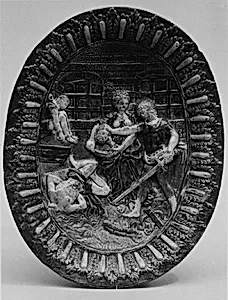
Dish with beheading of St. John the Baptist
second half 17th century
Medium
Lead-glazed earthenware
Dimensions
Overall: 1 7/8 × 11 1/16 × 8 13/16 in. (4.8 × 28.1 × 22.4 cm)
Classification
Ceramics-Pottery
Culture
French
Department
European Sculpture and Decorative Arts
Museum
Metropolitan Museum of Art, New York, NY
Credit
Gift of Julia A. Berwind, 1953
Accession Number
53.225.43
Rights
Public Domain
Tags
Art Historical Context
This striking lead-glazed earthenware, attributed to Bernard Palissy dating from the second half of the 17th century, depicts the dramatic biblical scene of the beheading St. John the Baptist Measuring just under 11 inches across, the shallow oval form features molded relief figures—including women and swordsmen—capturing the moment of the saint's martyrdom as recounted in the New Testament. The vibrant glazes, a hallmark of Palissy's techniques, bring vivid color and texture to the narrative, evoking the tension and tragedy of the event. Bernard Palissy (ca. 1510–1589), a pioneering French ceramicist, revolutionized pottery in Renaissance France with his "rustic" style, blending maiolica traditions with naturalistic motifs and bold religious imagery. Though Palissy himself was a Huguenot artisan who faced persecution for his Protestant faith, his workshop's influence persisted into the 17th century, producing wares like this for devout collectors. This piece exemplifies his mastery of lead glazing, which created durable, jewel-like finishes on earthenware, making fine art accessible beyond elite porcelain. Housed in the Metropolitan Museum of Art's European Sculpture and Decorative Arts collection (gift of Julia A. Berwind, 1953), the dish highlights the cultural role of ceramics in Counter-Reformation France, where vivid biblical scenes reinforced faith amid religious strife. A testament to Palissy's enduring legacy, it invites viewers to ponder the saint's sacrifice through masterful craftsmanship.
About the Artist
Bernard Palissy · 1510–1590
Bernard Palissy (c. 1510–1590), born to a poor family in the Saintonge region of France—possibly in Saintes, Périgord, or near Agen—began his career apprenticed to a glass painter before becoming a wandering journeyman portrait painter, glassworker, and land surveyor across France, the Low Countries, and Italy. He learned the rudiments of pottery in La Chapelle-des-Pots and settled in Saintes as a...