
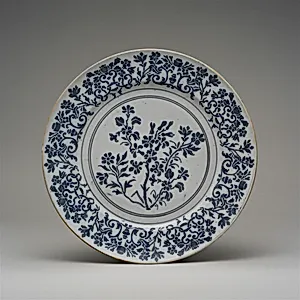
Dish with stenciled decoration
Medium
Hard-paste porcelain painted with cobalt blue under transparent glaze
Dimensions
Overall, irregular diameter (confirmed): 1 3/4 x 13 x 13 1/4 in. (4.4 x 33 x 33.7 cm)
Classification
Ceramics-Porcelain
Culture
Italian, Florence
Department
European Sculpture and Decorative Arts
Museum
Metropolitan Museum of Art, New York, NY
Credit
The Charles E. Sampson Memorial Fund, 1990
Accession Number
1990.312
Rights
Public Domain
Tags
Art Historical Context
This elegant dish, created around 1745 at the Doccia Porcelain Manufactory in Florence, represents one of Italy’s earliest successes in producing hard-paste porcelain. Founded by Marchese Carlo Ginori in 1735, the factory quickly became a center of innovation, allowing European artisans to rival the long-dominant Chinese and Japanese porcelain makers. The piece’s generous, slightly irregular form—roughly thirteen inches across—suggests it was intended as both a practical serving vessel and a display of technical mastery. The decoration employs cobalt blue painted beneath a transparent glaze, a technique that yields the crisp, luminous patterns seen here. Stenciled floral and plant motifs reflect the period’s fascination with nature while showcasing the precision possible with early European porcelain. Such underglaze painting ensured the design would remain durable through repeated use and cleaning. Today in the Metropolitan Museum of Art’s collection, this work highlights the artistic ambition and cultural exchange that shaped eighteenth-century decorative arts in Italy. Its refined balance of utility and beauty continues to invite viewers to appreciate the skill and vision behind Europe’s porcelain revolution.
About the Artist
Doccia Porcelain Manufactory|Marchese Carlo Ginori · 1737–1896
The Doccia Porcelain Manufactory, founded in 1737 by Marquis Carlo Ginori near Florence, holds the distinction of being Italy's first hard-paste porcelain manufacturer and one of the few European porcelain enterprises to survive from the eighteenth century to the present day without interruption. Unlike most contemporary ventures — which depended on the patronage and protection of ruling courts — ...