
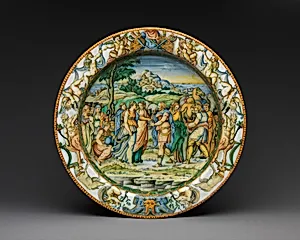
Dish with The Discovery of Achilles
ca. 1555–60
Medium
Maiolica (tin-glazed earthenware)
Dimensions
Overall (confirmed): 2 3/8 × 17 in. (6 × 43.2 cm)
Classification
Ceramics-Pottery
Culture
Italian, Urbino
Department
European Sculpture and Decorative Arts
Museum
Metropolitan Museum of Art, New York, NY
Credit
Rogers Fund, 1904
Accession Number
04.9.1
Rights
Public Domain
Tags
Art Historical Context
This exquisite maiolica dish, titled *The Discovery of Achilles* and produced around 1555–60 in the renowned Fontana workshops of Urbino, Italy, a pivotal moment from Greek mythology.ributed to the influential artist Battista Franco, it depicts clever unmasking of the hero Achilles, hidden among the daughters of King Lycomedes on the island of Skyros to the Trojan War. Odysseus him by presenting weapons amid women's finery, surrounded by figures of men, women, horses in dynamic poses. The large, shallow form—measuring just over 17 inches across—served as a luxurious centerpiece for Renaissance dining tables. Maiolica, tin-glazed earthenware, was a hallmark of Urbino's ceramic mastery during the 16th century, allowing artists to achieve brilliant blues, yellows, and reds on an opaque white ground. This technique, perfected in Italy after influences from Islamic and Hispanic traditions, elevated pottery to fine art, rivaling painting with its narrative detail and luster. The Fontana workshops were leaders in this "istoriato" style—history scenes on dishes—blending classical mythology with Mannerist elegance. Now in The Metropolitan Museum of Art's European Sculpture and Decorative Arts collection (acquired via Rogers Fund in 1904), this piece highlights Urbino's role as Europe's maiolica capital, where everyday objects became canvases for epic tales, delighting collectors then and now.
About the Artist
Fontana workshops|Battista Franco ( |Italian) · |1510 – |1561
|Italian, Venice ca. 1510–1561 Venice