
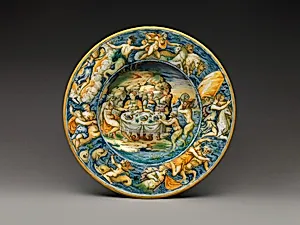
Dish Depicting Achelous and Theseus
ca. 1550–70
Medium
Maiolica (tin-glazed earthenware)
Dimensions
Overall (confirmed): 2 1/2 × 15 5/8 in. (6.4 × 39.7 cm)
Classification
Ceramics-Pottery
Culture
Italian, Venice
Department
European Sculpture and Decorative Arts
Museum
Metropolitan Museum of Art, New York, NY
Credit
Purchase, Count Pourtales Collection, 1887
Accession Number
87.6
Rights
Public Domain
Tags
Art Historical Context
This stunning maiolica dish, created by the Venetian artist Maestro Domenego da Venezia around 1550–70, exemplifies the Renaissance mastery of tin-glazed earthen. Measuring just 2½ inches high and 15⅝ inches wide, it was crafted in Venice, a hub of ceramic innovation where artisans like Domenego blended Islamic glazing techniques with Italian flair. The tin glaze produced a brilliant, glossy white surface ideal for vibrant polychrome decoration, making maiolica a prized export for dining and display across Europe. The central scene vividly depicts the mythological encounter between the hero Theseus and the river god Achelous, surrounded by dynamic human figures, horses, and fantastical mermaids—likely evoking sirens from classical lore. Theseus, the slayer of the Minotaur, confronts Achelous in a tale of shape-shifting and heroism drawn from Ovid's *Metamorphoses*, a favorite source for Renaissance artists celebrating antiquity. Housed in the Metropolitan Museum of Art since its 1887 purchase from the Count Pourtales Collection, this dish highlights Venice's role in popularizing narrative ceramics. Its intricate storytelling and luminous colors not only served practical purposes but also educated and entertained elite households, bridging ancient myths with 16th-century opulence.