
Disk Brooch
Unknown Artist
first half of the 6th century
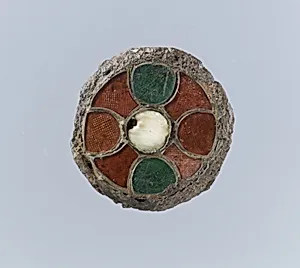
Medium
Copper alloy, garnets, green glass, with patterned foil backings...
Dimensions
Overall: 7/8 x 1/4 in. (2.2 x 0.6 cm)
Classification
Metalwork-Copper alloy
Culture
Frankish
Department
Medieval Art
Museum
Metropolitan Museum of Art, New York, NY
Credit
Gift of J. Pierpont Morgan, 1917
Accession Number
17.191.14
Rights
Public Domain
Art Historical Context
This exquisite Disk Brooch, crafted by an unknown Frankish artisan in the first half of the 6th century, exemplifies the masterful metalwork of the early Medieval period. Hailing from the Merovingian era—when the Franks dominated much of Western Europe—this small copper alloy piece (just 7/8 x 1/4 inches) served as a functional clasp for clothing while doubling as a symbol of status and wealth. Its diminutive size belies its grandeur, reflecting the portable luxury favored by elite warriors and nobility during the Migration Period. The brooch's artistry shines through its intricate inlays of garnets and green glass, set against patterned foil backings that created a shimmering, jewel-like effect. This technique, akin to cloisonné, involved soldering thin metal cells to hold the colorful stones and glass, with the foil beneath enhancing their brilliance through light refraction. Such methods highlight Frankish jewelers' skill in blending local traditions with Eastern influences, producing vibrant pieces that rivaled Byzantine opulence. A treasured gift to the Metropolitan Museum of Art from J. Pierpont Morgan in 1917, this brooch offers a glimpse into daily life among the Franks, where personal adornments conveyed power and piety. Visitors, imagine pinning this radiant treasure to your cloak— a tiny testament to an era of transformation and artistry.