
Disk Brooch
Unknown Artist
6th century
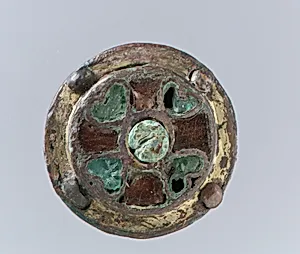
Medium
Copper alloy, gilded, mother-of-pear; garnets and green glass inlaid with silver foil backings; copper alloy back, no spring/pin extant
Dimensions
Overall: 1 x 11/16 in. (2.6 x 1.7 cm)
Classification
Metalwork-Copper alloy
Culture
Frankish
Department
Medieval Art
Museum
Metropolitan Museum of Art, New York, NY
Credit
Gift of J. Pierpont Morgan, 1917
Accession Number
17.191.17
Rights
Public Domain
Art Historical Context
This exquisite Disk Brooch, crafted by an unknown Frankish artisan in the 6th century, hails from the Merovingian era—a time when the Franks rose as a dominant power in post-Roman Europe, blending Germanic traditions with lingering Roman influences. Measuring just 1 x 1 11/16 inches (2.6 x 1.7 cm), this tiny jewel served as a cloak fastener, adorning the elite with its intricate design. Now housed in the Metropolitan Museum of's Medieval Art Department (gift of J. Pier Morgan, 1917), it exemplifies the sophisticated metalwork of early medieval Frankish culture. The brooch's face dazzles with copper alloy gilded for a golden sheen, inlaid with vibrant garnets, green glass, and mother-of-pearl, all backed by silver foil to amplify their luster—a technique known as foil-backed inlay, common in Migration Period jewelry. Though the copper alloy back survives without its original spring or pin, the preserved elements reveal masterful cloisonné-like cellwork, where gemstones were set into compartments for a gemmed, radiant effect. Such brooches were more than functional; they symbolized wealth and status among Frankish nobility, reflecting trade networks that brought exotic materials like garnets from India or Bohemia. This piece invites us to glimpse the artistry of a transformative age, where barbarian kingdoms forged a new aesthetic legacy.