
Disk Brooch
Unknown Artist
500–700
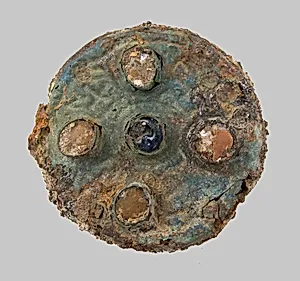
Medium
Copper alloy, iron core, glass paste or stone, evidence of gold foil
Dimensions
Overall: 1 3/4 x 11/16 in. (4.5 x 1.7 cm)
Classification
Metalwork-Copper alloy
Culture
Frankish
Department
Medieval Art
Museum
Metropolitan Museum of Art, New York, NY
Credit
Gift of J. Pierpont Morgan, 1917
Accession Number
17.191.281
Rights
Public Domain
Art Historical Context
This exquisite Disk Brooch, crafted by an unknown Frankish artisan between 500 and 700 CE, exemplifies the metalworking of the early medieval Merovingian period. Hailing from the Frankish culture that dominated much of Western Europe after the fall of Rome, such brooches served as practical fasteners for cloaks and garments while doubling as status symbols. Its petite size—measuring just 1 3/4 x 11/16 inches—highlights the skill required to create intricate jewelry on a small scale, likely worn by both men and women in daily life or for special occasions. Fashioned from copper alloy with a sturdy iron core, the brooch features decorations of glass paste or stone, along with traces of gold foil, suggesting techniques like inlay or gilding to mimic the opulence of gold and gemstones. These materials reflect resourcefulness in an era of transition, blending Roman influences with emerging Germanic styles in the Medieval Art tradition. A generous gift from J. Pierpont Morgan to The Metropolitan Museum of Art in 1917, this brooch offers a tangible glimpse into Frankish society, where personal adornment conveyed identity and wealth amid the dawn of the Middle Ages.