
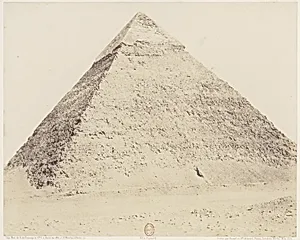
Djîzeh (Nécropole de Memphis), Pyramide de Chéphren
1851–52, printed 1853–54
Medium
Salted paper print from paper negative
Dimensions
24.2 x 30.2 cm. (9 1/2 x 11 7/8 in.)
Classification
Photographs
Department
Photographs
Museum
Metropolitan Museum of Art, New York, NY
Credit
Purchase, Lila Acheson Wallace Gift, 1976
Accession Number
1976.607.10
Rights
Public Domain
Tags
Art Historical Context
Step into ancient Egypt through Félix Teynard's *Djîzeh (Nécropole de Memphis), Pyide de Chéphren (1851–52, printed 1853–), a captivating salted paper print that immortalizes the Pyramid of Khafre—one of the iconic Giza trio. Captured during Teynard's pioneering photographic expedition along the Nile, this image showcases the pyramid's weathered limestone casing and monumental scale against the desert expanse. As a French photographer and draftsman, Teynard contributed to the 19th-century wave of European exploration that sought to document Egypt's pharaonic legacy amid growing archaeological interest. This 24.2 x 30.2 cm work exemplifies early calotype photography, using a paper negative to produce a salted paper print with its signature soft tones, subtle textures, and slight imperfections that lend an intimate, handcrafted feel. Printed by the Imprimerie Photographique de H. de Fonteny et Cie, it represents a technological marvel of the 1850s, bridging Talbot's invention with the quest to faithfully reproduce architectural wonders unattainable by earlier drawings alone. Housed in The Metropolitan Museum of Art's Photographs Department (Purchase, Lila Acheson Wallace Gift, 1976), this piece highlights photography's role in preserving cultural heritage, offering 19th-century viewers—and us—a direct glimpse of antiquity's enduring power.
About the Artist
Félix Teynard|Imprimerie Photographique de H. de Fonteny et Cie · 1817–1892
**Félix Teynard (1817–1892)** was a pioneering French photographer whose work captured the ancient wonders of Egypt and Nubia with unprecedented precision and artistry. Born on January 14, 1817, in Saint-Flour, he trained as a civil engineer in Grenoble, a hub of Egyptology that likely sparked his fascination with ancient architecture. Little is documented about his early life or formal photograph...