
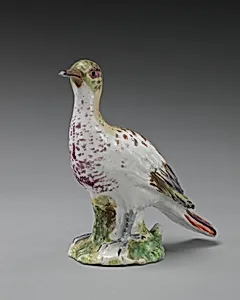
Dove (one of a pair)
ca. 1750
Medium
Soft-paste porcelain
Dimensions
5 1/2 × 5 in. (14 × 12.7 cm)
Classification
Ceramics-Porcelain
Culture
British, Chelsea
Department
European Sculpture and Decorative Arts
Museum
Metropolitan Museum of Art, New York, NY
Credit
Gift of Irwin Untermyer, 1964
Accession Number
64.101.428
Rights
Public Domain
Tags
Art Historical Context
Nestled in the Metropolitan Museum of Art's European Sculpture and Decorative Arts collection, *Dove (one of a)* from the Chelsea Porcelain Manufactory (ca. 1750) the delicate artistry of early British porcelain. Crafted from soft-p porcelain—a pioneering European substitute rare Chinese hard-paste petite figure (5 1/2 × 5 in.) a dove in exquisite detail, likely intended as a pair for mantelpieces or tabletops. Gifted by Irwin Untermyer in 4, it reflects the era's obsession with luxury ceramics. Chelsea, founded around 1743, was among England's first porcelain factories, thriving during the mid-18th-century "porcelain fever" sparked by German Meissen wares. Soft-paste porcelain, blending clay and glass frit, allowed for vibrant colors and intricate modeling at lower firing temperatures, though it was more fragile than true porcelain. Artisans at Chelsea excelled in naturalistic animal figures like this dove, often symbolizing peace or love in Rococo-inspired decorative schemes popular among the elite. This charming piece highlights Britain's innovative spirit in the decorative arts, bridging Eastern imports and Western ingenuity. Visitors will appreciate its lifelike plumage and poised elegance, a testament to Chelsea's brief but brilliant golden age before closing around 1769.
About the Artist
Chelsea Porcelain Manufactory · 1744–1784
**Chelsea Porcelain Manufactory** The Chelsea Porcelain Manufactory, Britain's pioneering porcelain enterprise, was founded around 1743 in Chelsea, London, by two Huguenot silversmiths: Nicholas Sprimont from Liège and Charles Gouyn. Sprimont, trained in Paris as a goldsmith before immigrating to England, brought his expertise in luxury metalwork to the venture, while Gouyn handled early sales th...