
Dr. Max Asch
1895
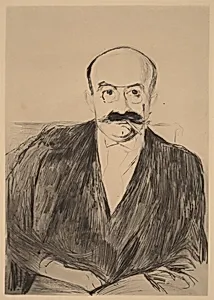
Medium
etching
Classification
Department
CG-E
Museum
National Gallery of Art, Washington, D.C.
Credit
Rosenwald Collection
Accession Number
1943.3.9025
Rights
Public Domain
Art Historical Context
Edvard Munch's *Dr. Max Asch* (1895) is a striking etching that captures the Norwegian artist's mastery of printmaking during a pivotal moment in his career. Created as an intimate portrait of the German physician Dr. Max Asch, this work exemplifies Munch's transition from Symbolism toward Expressionism, a movement he helped pioneer. At the time, Munch was living in Berlin, immersed in Europe's vibrant avant-garde scene, where he explored psychological depth and emotional intensity in his subjects. As an etching—a labor-intensive intaglio technique involving acid biting into a metal plate to create rich, textured lines—this print showcases Munch's innovative approach to reproduction. Unlike paintings, etchings allowed Munch to edition his works, making his art more accessible while experimenting with tonal contrasts and expressive distortions. The medium's precision highlights the doctor's contemplative gaze, blending clinical observation with personal insight. Housed in the National Gallery of Art's Rosenwald Collection (Department CG-E), this piece reflects Munch's broader fascination with portraiture as a window into the human soul. Visitors will appreciate how it bridges late 19th-century individualism with modern emotional rawness, offering a glimpse into the artist's evolving legacy.
About the Artist
Edvard Munch · 1863–1944
Edvard Munch (1863-1944) was a Norwegian painter and printmaker whose intensely psychological works made him a pioneer of Expressionism and one of the most influential artists of the modern era. His 1893 masterpiece 'The Scream' has become an iconic symbol of existential anxiety. Munch's art was profoundly shaped by personal tragedy—his mother died when he was five, his beloved sister Sophie at fo...