
Gunnar Heiberg
1896
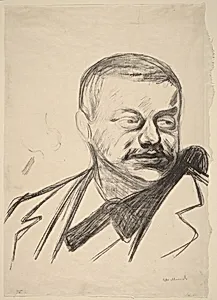
Medium
lithograph
Dimensions
sheet (irreg.): 47.5 × 34 cm (18 11/16 × 13 3/8 in.)
Classification
Department
CG-E
Museum
National Gallery of Art, Washington, D.C.
Credit
The Epstein Family Collection
Accession Number
1999.84.2
Rights
Public Domain
Art Historical Context
Edvard Munch's *Gunnar Heiberg* (1896) is a striking lithograph portrait capturing the Norwegian playwright and cultural figure Gunnar Heiberg, contemporary of Munch known for his provocative dramas. Created during Munch's prolific printmaking phase in the 1890s, this work measures 47.5 × 34 cm and exemplifies the artist's shift toward Expressionism, where emotional intensity and psychological depth eclipse realistic depiction. Munch, already famous for *The Scream* (1893), used prints like this to reach wider audiences beyond paintings, producing affordable multiples that spread his modernist vision across Europe. Lithography, a planographic technique involving greasy crayon on stone or metal, allowed Munch to achieve fluid lines and tonal subtleties with remarkable spontaneity—often printing editions himself for subtle variations. Here, the medium highlights Heiberg's intense gaze and angular features, evoking the inner turmoil Munch explored in his "Frieze of Life" series. Housed in the National Gallery of Art's Epstein Family Collection, this print reflects the bohemian circles of late 19th-century Oslo and Berlin, where artists and intellectuals like Heiberg fueled Munch's innovative Symbolist-Expressionist style. A testament to Munch's mastery of print, *Gunnar Heiberg* bridges portraiture and psychological portraiture, inviting viewers to ponder the subject's enigmatic presence amid Norway's cultural renaissance.
About the Artist
Edvard Munch · 1863–1944
Edvard Munch (1863-1944) was a Norwegian painter and printmaker whose intensely psychological works made him a pioneer of Expressionism and one of the most influential artists of the modern era. His 1893 masterpiece 'The Scream' has become an iconic symbol of existential anxiety. Munch's art was profoundly shaped by personal tragedy—his mother died when he was five, his beloved sister Sophie at fo...