
Dr. Wilhelm Wartmann
1922
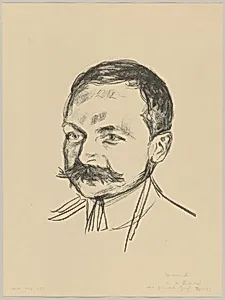
Medium
lithograph on wove paper
Dimensions
overall: 13 1/16 x 9 7/8 in
Classification
Department
CG-W
Museum
National Gallery of Art, Washington, D.C.
Credit
Gift of Epstein Family Collection
Accession Number
2022.172.40
Rights
Public Domain
Art Historical Context
Edvard Munch, the Norwegian artist renowned for his emotionally charged works and central role in the development of Expressionism, created this lithograph portrait of Dr. Wilhelm Wartmann in 1922. By this point in his career, Munch had already achieved international recognition, and his prints often explored psychological depth through simplified forms and expressive line work. The medium of lithography, which involves drawing directly onto a stone or plate, suited Munch’s spontaneous style and allowed him to produce multiple impressions that reached wider audiences than his paintings. Measuring just over 13 by 9 inches, the work exemplifies Munch’s later interest in portraiture, capturing the individuality of his subjects with economical yet evocative marks. As a print on wove paper, it highlights the democratic potential of graphic art in the early twentieth century, when artists like Munch used the technique to blend fine art with broader cultural commentary. This impression, now part of the National Gallery of Art’s collection through the generous gift of the Epstein Family, offers visitors a glimpse into Munch’s enduring fascination with human character and modern printmaking.
About the Artist
Edvard Munch · 1863–1944
Edvard Munch (1863-1944) was a Norwegian painter and printmaker whose intensely psychological works made him a pioneer of Expressionism and one of the most influential artists of the modern era. His 1893 masterpiece 'The Scream' has become an iconic symbol of existential anxiety. Munch's art was profoundly shaped by personal tragedy—his mother died when he was five, his beloved sister Sophie at fo...