
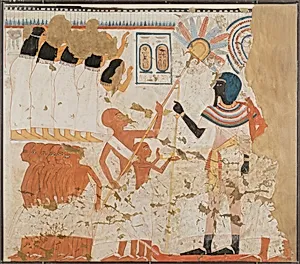
Dragging a Statue of Thutmose I
1911; original ca. 1294–1279 B.C.
Medium
Tempera on paper
Dimensions
Facsimile H. 64 x W. 75 cm (25 3/16 x 29 1/2 in.); Framed: H. 67.9 x W. 76.8 cm (26 3/4 x 30 1/4 in.); Scale. 1:1
Classification
Facsimile, Userhat (TT 51), Thutmose I
Period
Twentieth Century; original New Kingdom, Ramesside
Department
Egyptian Art
Museum
Metropolitan Museum of Art, New York, NY
Credit
Rogers Fund, 1915
Accession Number
15.5.17a
Rights
Public Domain
Tags
Art Historical Context
This tempera-on-paper facsimile captures a vivid scene from ancient Egypt’s New Kingdom, specifically Dynasty 19 (ca. 1294–1279 B.C.), when artisans adorned tomb or temple walls with images of royal and religious life. The original painting shows hauling a statue of the pharaoh Thutm I, a task that likely commemorated the king’s enduring legacy during the Ramesside period. Hieroglyphs and cartouches identify the figures and reinforce the scene’s ceremonial importance, while the presence of both men and women suggests communal participation in sacred processions. Norman de Garis Davies created this precise 1:1 copy in 1911 as part of the Metropolitan Museum’s efforts to document Egypt’s vanishing wall paintings. Working in tempera, he faithfully reproduced the original colors, gestures, and details before many ancient surfaces deteriorated. Such facsimiles remain invaluable for scholars and visitors, preserving the dynamic energy of Egyptian art—its emphasis on order, movement, and divine kingship—while allowing modern audiences to appreciate the skill of both the ancient artists and the twentieth-century copyist.
About the Artist
Norman de Garis Davies · 1865–1941
Norman de Garis Davies (1865–1941) was a British Egyptologist and archaeological artist whose meticulous copies of ancient Egyptian tomb paintings constitute one of the most important records of pharaonic art ever made. Born in Ashton-under-Lyne, Lancashire, he originally trained for the ministry before being drawn into Egyptology through his involvement with the Egypt Exploration Fund in the 1890...