
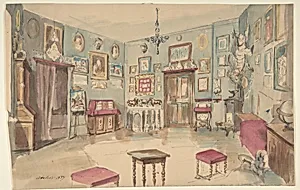
Drawing of an Interior: Atelier
Medium
Graphite, pen and blue ink, watercolor
Dimensions
sheet: 8 3/8 x 12 11/16 in. (21.3 x 32.3 cm)
Classification
Drawings
Department
Drawings and Prints
Museum
Metropolitan Museum of Art, New York, NY
Credit
Purchase, Anne and Carl Stern Gift, 1972
Accession Number
1972.642.3
Rights
Public Domain
Tags
Art Historical Context
Step into the intimate world of a 19th-century French artist's atelier with this delicate drawing from 1857. Created by anonymous French artist, *Drawing of an Interior: Atelier* offers a glimpse into the cluttered, creative sanctuary of a studio, filled with furniture and everyday objects that defined artistic life in mid-19th-century France. This period saw a growing fascination with domestic interiors, reflecting the era's shift toward Realism and everyday scenes amid rapid urbanization and industrialization in Paris. The artwork masterfully combines graphite for fine shading, pen and blue ink for precise lines, and watercolor for subtle color washes, creating depth and atmosphere on a modest sheet measuring 8 3/8 x 12 11/16 inches. These mixed-media techniques highlight the artist's skill in capturing light, texture, and spatial relationships—hallmarks of 19th-century draftsmanship prized for their immediacy and detail. Housed in the Metropolitan Museum of Art's Drawings and Prints department, this piece, acquired through the Anne and Carl Stern Gift in 1972, underscores the cultural value of anonymous works that preserve the mundane magic of creative spaces. It invites us to ponder the unsung hands behind the era's artistic fervor.
About the Artist
Anonymous, French, 19th century · 1800–1900
**Anonymous, French, 19th Century (ca. 1800–1900)** The artist cataloged as Anonymous, French, 19th century embodies the enigmatic yet essential contributions of unidentified creators to France's vibrant 19th-century art world. Active roughly between 1800 and 1900, this figure—or potentially collective workshop—produced a diverse array of works amid the nation's transition from Neoclassicism thro...