
Drawing of an Interior: Salon
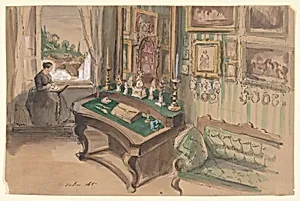
Medium
Pen and blue ink, watercolor, heightened with white
Dimensions
sheet: 6 1/8 x 9 1/2 in. (15.5 x 24.1 cm)
Classification
Drawings
Department
Drawings and Prints
Museum
Metropolitan Museum of Art, New York, NY
Credit
Purchase, Anne and Carl Stern Gift, 1972
Accession Number
1972.642.8
Rights
Public Domain
Tags
Art Historical Context
Step into the elegant world of a 19th-century French salon with this delicate *Drawing of an Interior:*, created anonymously in 1857. The intimate scene captures a refined domestic space, likely a bourgeois parlor, featuring women seated amid plush couches and ornate desks. These elements evoke the social heart of French middle-class homes during the Second Empire, where served as venues for conversation, tea, and intellectual exchange—a hallmark of the era's cultured lifestyle. Rendered in pen and blue ink with watercolor and white heightening on a modest 6 1/8 x 9 1/2-inch sheet, the artwork showcases virtuoso mixed-media techniques popular among French draftsmen. The blue ink lends a cool, atmospheric tone, while watercolor adds subtle color washes and the white heightening creates luminous highlights, mimicking the play of natural light on fabrics and woodwork. This approach, common in preparatory studies or collector's pieces, highlights the artist's keen observation of texture and space. Acquired by the Metropolitan Museum of Art in 1972 through the Anne and Carl Stern Gift, this drawing offers a poignant snapshot of everyday opulence. It invites us to ponder the unseen lives of its female figures—perhaps hostesses or visitors—and the evolving role of interiors in 19th-century art, bridging realism and romanticism in an anonymous yet masterful hand. (198 words)
About the Artist
Anonymous, French, 19th century · 1800–1900
**Anonymous, French, 19th Century (ca. 1800–1900)** The artist cataloged as Anonymous, French, 19th century embodies the enigmatic yet essential contributions of unidentified creators to France's vibrant 19th-century art world. Active roughly between 1800 and 1900, this figure—or potentially collective workshop—produced a diverse array of works amid the nation's transition from Neoclassicism thro...