
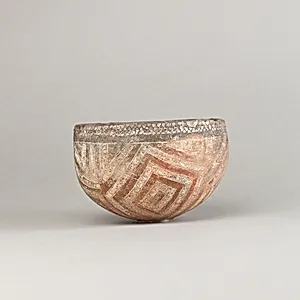
Drinking Cup
Unknown Artist
ca. 1900–1550 B.C.
Medium
Polished black ware with decoration filled with white pigment
Dimensions
h. 9 cm (3 9/16 in); diam. 14 cm (5 1/2 in)
Classification
Cup, geometric decoration
Period
C-Group
Department
Egyptian Art
Museum
Metropolitan Museum of Art, New York, NY
Credit
Rogers Fund, 1913
Accession Number
13.125.27
Rights
Public Domain
Art Historical Context
Step into the world of ancient Nubia with this elegant *Drinking Cup* from the C-Group period (ca. 1900–1550 B.C.), a vibrant culture that flourished along the Nile in what is now southern Egypt and northern Sudan. Created by an unknown artisan, this small vessel—standing just 9 cm tall and 14 cm wide—was likely used in daily rituals or communal feasting, bridging the gap between everyday life and cultural expression. The C-Group people, influenced by their Egyptian neighbors yet distinctly Nubian, produced ceramics that highlight their role as key traders and intermediaries in the Nile Valley. Crafted from polished black ware, the cup's glossy surface was achieved through meticulous burnishing, a technique that creates a striking, mirror-like sheen resistant to wear. Delicate decorations, incised into the clay and filled with white pigment, provide vivid contrast—possibly geometric patterns or motifs symbolizing fertility, protection, or the Nile's life-giving waters. This labor-intensive method not only enhanced beauty but also durability, making it a testament to skilled craftsmanship in a pre-industrial age. Acquired by The Metropolitan Museum of Art through the Rogers Fund in 1913, this cup offers a window into C-Group society, where pottery served both practical and symbolic purposes amid growing Egyptian influence before the New Kingdom conquests. A humble yet masterful survivor from over 3,500 years ago, it invites us to sip from the past.