
Drinking Vessel with Banqueting Youths
5th century BC
Medium
ceramics
Classification
ceramics
Department
Smithsonian Collection
Museum
Smithsonian American Art Museum
Credit
Gift of the Heirs of Beatrix Farrand
Accession Number
1959-153-2
Rights
Public Domain
About this artwork
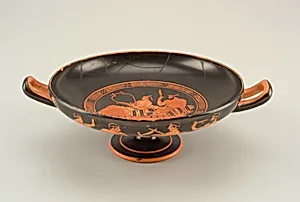
Shallow circular bowl on pedestal foot; two, squared-loop handles; black ground of Interior with central red-orange decoration showing scene of two youths reclining on couch, one lifting phiale, the other playing a lyre, the scene framed by a circular band of alternating key and checkerboard patterns. Black ground of bowl exterior with red-orange decoration consisting of palmettes surrounding handles; between handles, on either side, tableaus of reveling youths on couches similar to scene in bow...
Art Historical Context
Step into the lively world of ancient Greece with this exquisite 5th-century BC drinking vessel, known as a *kylix*. Crafted from ceramics, it's a shallow circular bowl elevated on a pedestal foot with two squared-loop handles, perfectly suited for sipping wine at elite symposia—those intimate male banquets blending conversation, music, and revelry. Housed in the Smithsonian American Art Museum as a gift from the heirs of Beatrix Farrand, this piece captures the elegance of Classical Athenian pottery. The interior boasts a vibrant red-orange scene on a glossy black ground: two youthful revelers recline on a couch, one gracefully lifting a phiale (a shallow libation bowl) in toast, while the other strums a lyre. This intimate tableau, framed by a band of key and checkerboard patterns, evokes the symposion's cultured atmosphere. The exterior echoes the theme with palmette motifs flanking the handles and matching vignettes of banqueting youths on either side, creating a 360-degree celebration of youth and leisure. Masterfully executed in the red-figure technique—where figures are left in the clay's natural red-orange hue against a black slip background—this kylix highlights Athenian potters' precision and storytelling prowess. It offers a window into 5th-century BC social rituals, where such vessels weren't just functional but symbols of sophistication and joy.
About the Artist
Unknown
The artist designated as "Unknown" in our virtual museum's collection exemplifies a poignant chapter in art history: creators whose identities have faded into obscurity despite the enduring power of their work. With only one known artwork attributed to them in our holdings, this figure represents countless anonymous hands that shaped visual culture across centuries. Museums worldwide, including th...