
Duck Decoy
1937
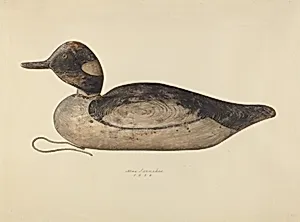
Medium
watercolor and graphite on paper
Dimensions
overall: 29.3 x 39.8 cm (11 9/16 x 15 11/16 in.) Original IAD Object: 12 3/4" long; 5 1/2" high
Classification
Index of American Design
Department
CG-W
Museum
National Gallery of Art, Washington, D.C.
Credit
Index of American Design
Accession Number
1943.8.17980
Rights
Public Domain
Art Historical Context
**Duck Decoy** by Max Fernekes (1937) is a captivating watercolor and graphite rendering on paper, measuring 29.3 x 39.8 cm. This precise depiction captures a traditional wooden duck decoy—originally 12 3/4 inches long and 51/2 inches highshowcasing the intricate carving and painting that brought these functional objects to life. Fernekes, a illustrator, employed delicate washes of watercolor to mimic the decoy's feathered textures and subtle color gradients, enhanced by fine graphite lines for anatomical accuracy. Created as part of the *Index of American Design* (IAD), a Federal Art Project under the Works Progress Administration during the Great Depression, this work belongs to a monumental effort to document and celebrate everyday American folk art and craftsmanship. From 1935 to 1942, over 15,000 such renderings preserved vanishing traditions, now housed in collections like the National Gallery of Art's Department of CG-W. Duck decoys embody early American ingenuity, handcrafted by hunters along coastal and marshy regions to lure waterfowl. Fernekes' artwork elevates this vernacular craft into high art, highlighting its cultural role in hunting heritage and the beauty of utilitarian design. A testament to America's artistic diversity, it invites us to appreciate the anonymous makers whose skills shaped our shared history.