
Decoy Duck #1
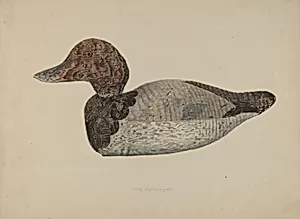
Medium
watercolor, graphite, and colored pencil on paperboard
Dimensions
overall: 30.8 x 40.9 cm (12 1/8 x 16 1/8 in.)
Classification
Index of American Design
Department
CG-W
Museum
National Gallery of Art, Washington, D.C.
Credit
Index of American Design
Accession Number
1943.8.9621
Rights
Public Domain
Art Historical Context
**Decoy Duck #1** (1938) by Lloyd Lemcke captures the whimsical charm of a classic American folk art object—a wooden duck decoy used by hunters to lure waterfowl. Created with watercolor, graphite, and pencil on paperboard (30.8 x 40.9 cm), this detailed rendering showcases the decoy's hand-carved form, vibrant plumage, and subtle sculptural details, bringing to life an everyday tool turned art form. As part of the *Index of American Design*, Works Progress Administration (WPA project from the 1930s, Lemcke's work documents the nation's folk heritage during the Great Depression. Artists across the U.S. produced thousands of such precise, colorful studies of utilitarian objects, preserving regional craftsmanship for future generations. Housed in the National Gallery of Art, it highlights duck decoys as emblems of early American ingenuity, particularly from coastal carving traditions. Lemcke's mixed-media technique allows for lifelike texture and depth—the graphite outlines precise contours, while watercolors and colored pencils add glossy feathers and glassy eyes. This piece invites visitors to appreciate how ordinary hunting gear embodied artistic skill, bridging utility and beauty in American culture.
About the Artist
Lloyd Charles Lemcke · 1855–present
Lloyd Charles Lemcke was an American artist active around 1935, best known for his contributions to the Index of American Design, a Federal Art Project initiative under the Works Progress Administration (WPA) that aimed to document the nation's folk crafts and vernacular objects through precise artistic renderings. Little is known about Lemcke's early life or formal training, as biographical detai...