
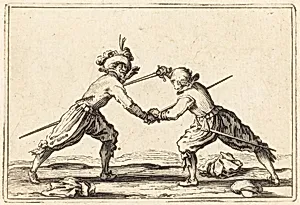
Duel with Swords
c. 1622
Medium
etching on laid paper
Dimensions
plate: 5.9 × 8 cm (2 5/16 × 3 1/8 in.) sheet: 7.3 × 10.2 cm (2 7/8 × 4 in.)
Classification
Department
CG-E
Museum
National Gallery of Art, Washington, D.C.
Credit
R.L. Baumfeld Collection
Accession Number
1969.15.473
Rights
Public Domain
Art Historical Context
Jacques Callot's *Duel with Swords* (c. 1622) is a captivating etching on laid paper, measuring just 5.9 × 8 cm on the plate—a testament to the artist's extraordinary skill in rendering intricate drama on a minuscule scale. Working in the Baroque era, Callot (1592–1635), a French printmaker who spent much of his career in Florence under Medici patronage, mastered etching to produce highly detailed scenes of everyday life, theater, and conflict. This print, from the National Gallery of's R.L. Baumfeld Collection, exemplifies his ability to pack narrative energy into pocket-sized works. The scene depicts a tense sword fight, likely evoking the illicit duels rampant among 17th-century European nobility. Despite royal bans, such combats symbolized honor and bravado, reflecting the era's social tensions amid the Thirty Years' War's shadow. Callot's prints often captured these raw human moments with unflinching realism, blending satire and pathos. Etching allowed Callot to achieve unprecedented line density—up to thousands per square inch—creating depth, motion, and texture through subtle biting of acid on copper plates. Printed on laid paper, which shows its characteristic chain lines, this work highlights printmaking's rise as an accessible art form, disseminating vivid vignettes to a wide audience beyond elite courts. A gem for print enthusiasts, it invites close inspection to uncover its lively details.
About the Artist
Jacques Callot · 1592–1635
Jacques Callot (1592–1635) was a French printmaker and draftsman from the Duchy of Lorraine, widely regarded as one of the first great artists to practice the graphic arts exclusively. His more than 1,400 etchings chronicled the breadth of 17th-century life, from Medici court festivities to the brutal realities of warfare. Callot revolutionized etching through technical innovations including the é...