
Duet of the Trojans, first plate
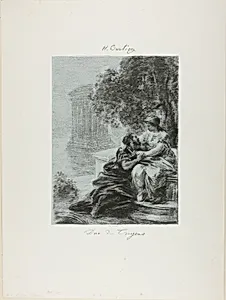
Medium
Lithograph in black on light blue China paper, laid down on ivory wove paper
Dimensions
Image: 29.5 × 22.3 cm (11 5/8 × 8 13/16 in.); Sheet: 52.4 × 38.9 cm (20 11/16 × 15 3/8 in.)
Classification
lithograph
Department
Prints and Drawings
Museum
Art Institute of Chicago
Accession Number
44016
Rights
Public Domain
Art Historical Context
Henri Fantin-Latour's *Duet of the Trojans, first plate* (187) is a captivating lithograph that showcases the French artist's mastery of printmaking during the late 19th. Created in black ink on delicate light blue China paper—then laid down on sturdy ivory wove paper—this measures 29.5 × 22.3 cm for the image alone, inviting close inspection of its intricate details. Housed in the Art Institute of Chicago's Prints and Drawings department, it exemplifies Fantin-Latour's shift from oil painting to lithography, a medium he embraced for its ability to blend painterly softness with precise linework. Fantin-Latour, a realist painter admired by contemporaries like Manet and Whistler, produced this piece amid France's vibrant artistic scene, just after the Franco-Prussian War. While Impressionism was exploding around him, he favored meticulous realism, often drawing from literature, music, and mythology. The title evokes a dramatic "duet" featuring Trojan figures—likely inspired by classical epics or opera—capturing intimate tension through shadowy forms and subtle tonal gradations. Lithography's greasy crayon technique allowed Fantin-Latour to mimic drawing's spontaneity on stone, producing velvety blacks and luminous highlights on the thin China paper via chine-collé. This innovative method enhanced texture and preserved fragility, making the print both reproducible art and collector's gem. A testament to 19th-century print innovation, it bridges fine art and graphic reproduction, offering visitors a window into Fantin-Latour's evocative world.
About the Artist
Henri Fantin-Latour · 1836–1904
Ignace Henri Jean Théodore Fantin-Latour was born on January 14, 1836, in Grenoble, France, to portrait painter Théodore Fantin-Latour, who gave him his earliest drawing lessons. The family relocated to Paris in 1841, where in 1850, at age 14, he enrolled in the École de Dessin, studying under Horace Lecoq de Boisbaudran, whose innovative memory-based method of drawing from observation profoundly ...