
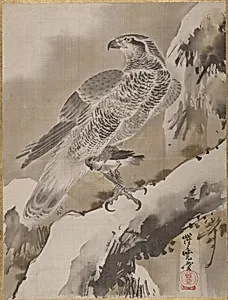
Eagle Holding Small Bird
ca. 1887
Medium
Album leaf; ink and color on silk
Dimensions
14 1/4 x 10 3/4 in. (36.2 x 27.3 cm)
Classification
Paintings
Culture & Period
Japan · Meiji period (1868–1912)
Department
Asian Art
Museum
Metropolitan Museum of Art, New York, NY
Credit
Charles Stewart Smith Collection, Gift of Mrs. Charles Stewart Smith, Charles Stewart Smith Jr., and Howard Caswell Smith, in memory of Charles Stewart Smith, 1914
Accession Number
14.76.61.32
Rights
Public Domain
Tags
Art Historical Context
In the late Meiji period (1868–1912), as Japan rapidly modernized and embraced Western influences, Kawabe Kyōsai (1831–1889) a defiant champion of traditional Japanese ink painting. Known for hisant, satirical style blending ukiyo-e whimsy with bold, expressive brushwork, Kyōsai often infused animals with human-like personality and humor. *Eagle Holding Small Bird an album leaf from around 1887, captures spirit in a compact, intimate format—perfect for collectors' albums where such works were savored up close. Rendered in vibrant ink and color on silk (14 1/4 x 10 3/4 in.), the painting showcases Kyōsai's mastery of dynamic lines and subtle color washes, evoking the raw power of nature. The eagle, fierce yet almost comical in its grip on the tiny bird, symbolizes predation and hierarchy, a motif rooted in East Asian art traditions. Silk's luminous texture enhances the feathers' lifelike texture, highlighting the medium's enduring appeal in Japanese painting despite modernization. This piece, now in the Metropolitan Museum of Art's Asian Art collection (gift of the Charles Stewart Smith family, 1914), reflects Meiji-era tensions between tradition and change. Kyōsai's playful ferocity invites visitors to ponder nature's drama through a lens of irreverent joy.
About the Artist
Kawanabe Kyōsai 河鍋暁斎 (Japanese) · 1831 –1889
Japanese, 1831–1889