
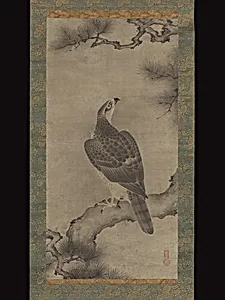
狩野之信筆 松鷹図|Hawk on a Pine
mid-16th century
Medium
Hanging scroll; ink on paper
Dimensions
Image: 32 7/8 × 16 7/16 in. (83.5 × 41.7 cm) Overall with mounting: 63 3/8 × 20 3/4 in. (161 × 52.7 cm) Overall with knobs: 63 3/8 × 22 15/16 in. (161 × 58.3 cm)
Classification
Paintings
Culture & Period
Japan · Muromachi period (1392–1573)
Department
Asian Art
Museum
Metropolitan Museum of Art, New York, NY
Credit
Mary and Cheney Cowles Collection, Gift of Mary and Cheney Cowles, 2018
Accession Number
2018.853.8
Rights
Public Domain
Tags
Art Historical Context
This striking ink painting, *Hawk on a Pine*, was created by Kano Yukinobu during Japan’s Muromachi period (1392–1573). As a member of the influential Kano school, Yukinobu worked in an era when Zen Buddhist aesthetics profoundly shaped Japanese art. The hanging scroll format, measuring just over 32 inches in height, was designed for intimate viewing in a temple alcove or study, where the image could be unrolled and contemplated in quiet reflection. Executed in monochrome ink on paper, the work exemplifies the suiboku-ga tradition, in which varying tones of black ink and fluid brushstrokes capture the essence of the subject rather than literal detail. The hawk, perched alertly on a pine branch, conveys vigilance and strength through economical yet powerful lines. Such bird-and-flower subjects were popular among the military elite, who admired the hawk’s association with martial prowess and noble character. Today in the Metropolitan Museum’s collection, the scroll offers visitors a window into the refined visual language of 16th-century Japan, where nature imagery served both meditative and symbolic purposes.