
Ecce Homo
1575–1699
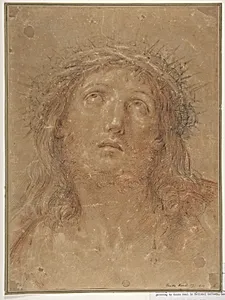
Medium
Black and red chalk on brownish paper
Dimensions
16 x 11 3/4 in. (40.5 x 29.9 cm)
Classification
Drawings
Department
Drawings and Prints
Museum
Metropolitan Museum of Art, New York, NY
Credit
Gift of Cornelius Vanderbilt, 1880
Accession Number
80.3.321
Rights
Public Domain
Tags
Art Historical Context
Behold the poignant "Ecce Homo" by Reni, a masterful drawing from the late 16th to 17th century that captures biblical moment when Pontius Pilate presents the crowned Christ to the crowd, uttering "Ecce Homo" (Behold the Man). Reni, a leading figure of the Bolognese school Baroque era, was renowned for his graceful, idealized religious figures blending classical elegance with emotional depth. This intimate study exemplifies his skill in evoking Christ's suffering and divinity through subtle expression and poised posture. Executed in black and red chalk on brownish paper, the work measures 16 x 11 3/4 inches, a modest scale that invites close contemplation. The dual-chalk technique allows Reni to achieve rich tonal contrasts—blacks for shadows and dramatic highlights, reds for flesh tones—creating a luminous, sculptural quality typical of preparatory drawings for larger paintings or engravings. Such sheets were prized in Reni's time for their spontaneity and virtuoso handling, bridging studio practice and finished art. Acquired as a gift from Cornelius Vanderbilt in 1880, this treasure resides in the Metropolitan Museum of Art's Drawings and Prints department. It offers visitors a window into Counter-Reformation devotion, where art stirred faith amid turbulent times, reminding us of art's enduring power to humanize the divine.
About the Artist
Guido Reni · 1575–1642
Guido Reni (1575–1642) was one of the most celebrated Italian painters of the Baroque era and the dominant figure of the Bolognese School. Born into a family of musicians in Bologna, he trained first with Denys Calvaert before joining the influential Accademia degli Incamminati led by Ludovico Carracci. Reni achieved international fame through his idealizing style that combined Baroque dynamism wi...