
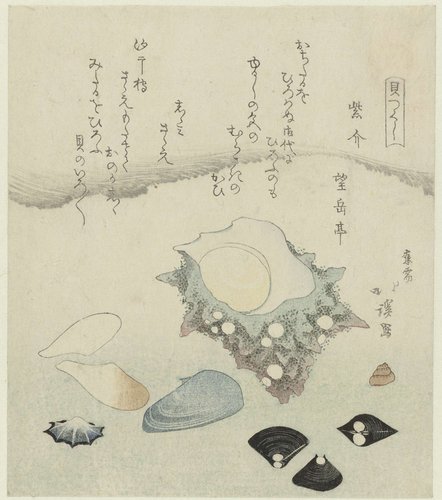
Een serie van schelpen
1821
Medium
nishikie, with metallic pigments and blindprinting
Dimensions
178; 205
Rights
Public Domain
About this artwork
collector's mark, verso, stamped: Lugt 2228
Art Historical Context
**Een serie van schel (A Series of Shells)** *Totoya Hokkei, 1821* *Nishikie woodblock with metallic pigments and blind, 205 × 178 mm* Step into the delicate world of Edo-period Japan with Totoya Hokkei's *Een serie van schel*, a charming nishikie print from 1821. Hokkei, a skilled pupil the legendary Katsushika Hokusai, was a master of ukiyo-e—the "pictures of the floating world" captured everyday beauty with vibrant flair. This intimate work, likely a surimono (luxury private print), depicts a series of seashells, celebrating nature's intricate forms during Japan's vibrant late Edo era, when such prints were prized by poetry circles and collectors. The medium shines here: nishikie, or "brocade pictures," refers to full-color woodblock prints renowned for their jewel-like hues achieved through precise carving and multiple ink layers. Hokkei elevates it with metallic pigments for a shimmering, opulent glow—evoking the iridescence of real shells—and blindprinting (gauffrage), which embosses textures without ink, adding a tactile depth rare in mass-produced prints. At just 20.5 × 17.8 cm, it's perfectly sized for albums or fans. Bearing a collector's mark (Lugt 2228) on the verso, this piece bridges Japanese artistry with European connoisseurship, highlighting ukiyo-e's global allure. A testament to technical innovation and quiet wonder, it invites you to linger on nature's poetry.
About the Artist
Totoya Hokkei · 1780–1850
Totoya Hokkei (魚屋 北渓, 1780–1850), born Iwakubo Tatsuyuki in Edo (modern Tokyo), began his life as a humble fishmonger in the Yotsuya Samegahashi district, a trade reflected in his art name "Totoya," meaning fish shop. He transitioned to art through rigorous training, first studying under Kanō Yōsen'in Korenobu, head of the Kobikichō branch of the prestigious Kanō school, where he honed landscape p...