
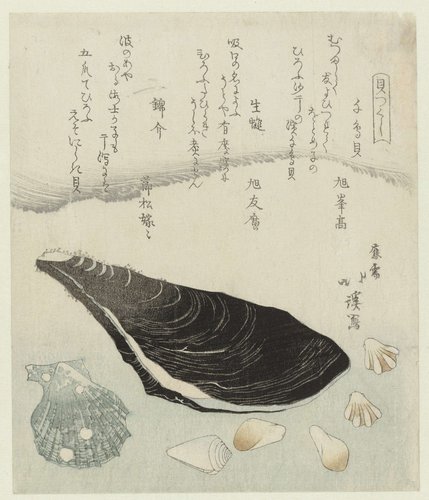
Een serie van schelpen
1821
Medium
nishikie, with metallic pigments and blindprinting
Dimensions
204; 174
Rights
Public Domain
About this artwork
height 204 mm x width 174 mm
Art Historical Context
**Een serie van schelpen (A Series of Shells *Totoya Hokkei, 1821* *Nishikie woodblock with metallic pigments and blind, 204 × 174 mm* Created by Totoya Hokkei, a Japanese ukiyo-e artist and pupil of the legendary Katsushika Hokusai, *Een serie van schelpen* dates to 1821 during Japan's Edo period. This intimate print captures a delicate series of seashells, reflecting the ukiyo-e tradition of celebrating the fleeting beauty of nature amid urban life's "floating world." Hokkei's precise lines and harmonious compositions echo his master's innovative style, blending realism with poetic elegance in a compact format ideal for personal collections or surimono—custom prints often exchanged as gifts. The medium, nishikie or "brocade picture," represents the zenith of woodblock printing artistry, layering vibrant colors from multiple carved blocks for jewel-like depth. Hokkei elevates this with metallic pigments—likely gold or silver flecks evoking shimmering shells—and blindprinting (gauffrage), an embossing technique that adds subtle texture without ink, inviting viewers to appreciate its tactile allure up close. At just 20 cm tall, it exemplifies accessible luxury art for Edo Japan's cultured elite. These shells symbolize transience and marine wonders, tying into Japan's deep reverence for the sea. A charming window into 19th-century printmaking mastery, Hokkei's work highlights ukiyo-e's influence on global art, from Impressionism to modern design. (198 words)
About the Artist
Totoya Hokkei · 1780–1850
Totoya Hokkei (魚屋 北渓, 1780–1850), born Iwakubo Tatsuyuki in Edo (modern Tokyo), began his life as a humble fishmonger in the Yotsuya Samegahashi district, a trade reflected in his art name "Totoya," meaning fish shop. He transitioned to art through rigorous training, first studying under Kanō Yōsen'in Korenobu, head of the Kobikichō branch of the prestigious Kanō school, where he honed landscape p...