
Egge (Harrow)
1916
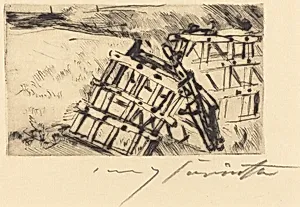
Medium
drypoint in black on wove paper
Dimensions
plate: 7.7 x 13 cm (3 1/16 x 5 1/8 in.) sheet: 20.6 x 26.2 cm (8 1/8 x 10 5/16 in.)
Classification
Department
CG-W
Museum
National Gallery of Art, Washington, D.C.
Credit
Rosenwald Collection
Accession Number
1951.10.276
Rights
Public Domain
Art Historical Context
Lovis Corinth's *Egge (Harrow)*, created in 1916, captures the stark beauty of rural labor through a masterful drypoint print on wove paper. This intimate work, with its plate measuring just 7.7 x 13 cm, depicts a harrow—an agricultural tool for breaking up soil—evoking the timeless rhythm of the German countryside. Corinth, a leading figure in German Expressionism, transitioned from Impressionist influences to a bolder, more introspective style after a debilitating stroke in 1911, infusing his prints with raw emotional depth and dramatic contrasts. Drypoint, Corinth's chosen technique here, involves scratching directly into a metal plate with a sharp needle, raising a soft burr that yields richly textured, velvety lines in the black ink. This method allowed for spontaneous, expressive mark-making, perfect for conveying the harrow's angular forms against the vast landscape. Printed on smooth wove paper, the edition from the Rosenwald Collection at the National Gallery of Art preserves the print's delicate tonal nuances. Produced amid World War I, *Egge (Harrow)* reflects Corinth's enduring fascination with nature's resilience, a quiet counterpoint to the era's turmoil. Its small scale invites close contemplation, highlighting how printmaking democratized access to fine art, bridging artist and viewer in shared wonder.
About the Artist
Lovis Corinth · 1858–1925
Lovis Corinth, born Franz Heinrich Louis on July 21, 1858, in Tapiau, East Prussia (now Gvardeysk, Russia), to a tanner father, displayed prodigious drawing talent from childhood. He began formal training at the Königsberg Academy in 1876, then moved to the Academy of Fine Arts in Munich from 1880 to 1884, studying under Ludwig von Löfftz and briefly Franz von Defregger, where he absorbed a Realis...