
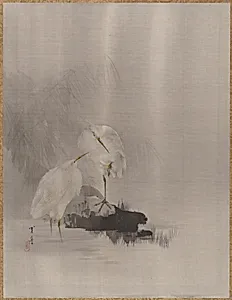
Egrets at the Water's Edge
ca. 1887
Medium
Album leaf; ink and color on silk
Dimensions
14 x 10 3/4 in. (35.6 x 27.3 cm)
Classification
Paintings
Culture & Period
Japan · Meiji period (1868–1912)
Department
Asian Art
Museum
Metropolitan Museum of Art, New York, NY
Credit
Charles Stewart Smith Collection, Gift of Mrs. Charles Stewart Smith, Charles Stewart Smith Jr., and Howard Caswell Smith, in memory of Charles Stewart Smith, 1914
Accession Number
14.76.61.52
Rights
Public Domain
Tags
Art Historical Context
Nestled in the elegant intimacy of an album leaf, *Egrets at the's Edge* (ca. 1887) by Watanabe Seitei captures the serene poise of birds poised at the water's brink. Created during Japan's Meiji period (186–1912), a time of rapid modernization and cultural exchange with the West, this work exemplifies Seitei's mastery of *kacho-e*—paintings of birds and flowers Trained in traditional Japanese techniques, Seitei infused his art with subtle Western realism, delicate ink lines with soft colors to evoke nature's quiet harmony. Rendered in ink and color on silk, the 14 x 10 3/4-inch leaf showcases the medium's luminosity and fine texture, ideal for personal albums cherished by collectors. Silk allowed for the artist's precise brushwork, highlighting the egrets' elegant feathers and rippling water with a lifelike yet poetic touch. This format underscores the artwork's role in private contemplation, contrasting the era's public embrace of industrialization. Housed in the Metropolitan Museum of Art's Asian Art collection, gifted in 1914 from the Charles Stewart Smith family, the piece reflects Meiji Japan's artistic resilience. Seitei's birds, symbols of purity and grace in Japanese culture, invite visitors to pause and appreciate nature's timeless beauty amid historical change.