
Elevation and Section
16th century
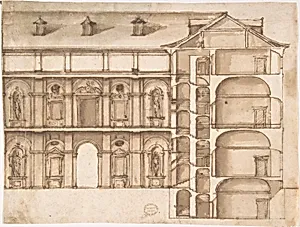
Medium
Pen and brown ink, washed
Dimensions
9-3/4 x 7 in. (24.8 x 17.8 cm)
Classification
Drawings
Department
Drawings and Prints
Museum
Metropolitan Museum of Art, New York, NY
Credit
Gift of Cornelius Vanderbilt, 1880
Accession Number
80.3.616
Rights
Public Domain
Tags
Art Historical Context
Step into the world of Renaissance architecture with *Elevation and Section*, an exquisite anonymous drawing from 16th-century Italy. Created with pen and brown ink enhanced by subtle washes, this intimate sheet (9-3/4 x 7 in.) presents a precise front elevation and cross-section of a building, likely a grand ecclesiastical or palatial structure. Such technical renderings were essential tools for architects and builders, bridging the gap between design conception and construction during Italy's architectural golden age. In the 16th century, Italy buzzed with innovation inspired by classical antiquity and masters like Palladio and Serlio, who revived Vitruvian principles of proportion and harmony. This drawing exemplifies the era's meticulous drafting techniques: fine pen lines delineate structural details, while brown ink washes add tonal depth, simulating light and shadow to convey three-dimensionality on a flat surface. Though anonymous, it reflects the collaborative workshops where ideas flowed freely among artists and engineers. A cherished gift to the Metropolitan Museum of Art from Cornelius Vanderbilt in 1880, this work offers a window into the intellectual rigor of Renaissance design. Housed in the Drawings and Prints department, it invites visitors to appreciate how simple ink on paper shaped enduring skylines, blending artistry with engineering prowess.