
Elizabeth Knapp
1802
Medium
Painting-Miniature
Classification
Painting-Miniature
Department
Smithsonian Collection
Museum
Smithsonian American Art Museum
Credit
Smithsonian American Art Museum, Museum purchase through the Catherine Walden Myer Fund
Accession Number
1937.11.1
Rights
Public Domain
Tags
About this artwork
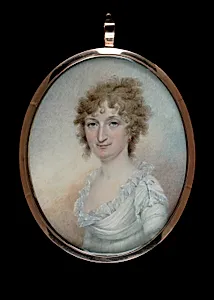
There are numerous women by this name who lived during the time James Peale was painting miniatures, making it difficult to determine exactly who this sitter might be. However, an Elizabeth Knapp of Danbury, Connecticut, died about 1802, and it is possible that this miniature was painted to commemorate her passing. The back of the locket contains a lock of her hair, bound in gold thread and set with pearls.
Art Historical Context
In the early 19th century, Peale, a prominent American artist and brother to the famed Charles Willson Peale, excelled in the intimate art of miniature painting. This 1802 bust-length portrait of *Elizabeth Knapp*, rendered on ivory in watercolor, exemplifies his skill in capturing delicate facial features and lifelike expressions on a tiny scale—typically just a few inches across. Housed in the Smithsonian American Art Museum, the piece was acquired through the Catherine Walden My Fund, preserving a gem of early American portraiture. The sitter's identity remains elusive, as several women named Elizabeth Knapp lived during Peale's active years painting miniatures. One intriguing possibility is Elizabeth Knapp of Danbury, Connecticut, who died around 1802, suggesting this work may have served as a poignant memorial. Adding to its emotional depth, the reverse of the locket framing the portrait contains a lock of her hair, intricately bound with gold thread and adorned with pearls—a cherished 19th-century custom blending remembrance with jewelry. Miniatures like this were personal treasures, often worn as pendants or brooches, symbolizing affection, loss, or legacy in a young nation. Peale's precise technique and subtle shading highlight the genre's significance: accessible yet sophisticated keepsakes that brought portraiture to everyday Americans, bridging Revolutionary-era formality with emerging sentimental traditions.
About the Artist
James Peale · 1749–1831
James Peale was an American painter born in 1749, the younger brother of the more famous Charles Willson Peale, and a member of one of the most remarkable artistic families in the history of American art. Trained largely by his brother, James worked for many years in Charles Willson's shadow, assisting with portraits and miniatures in the Philadelphia studio before developing his own independent p...