
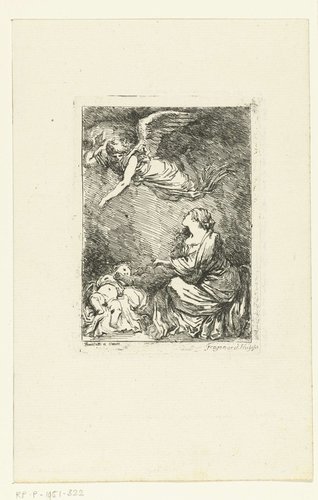
Engel wijst Hagar de waterbron
1763 - 1764
Medium
etching
Dimensions
118; 87
Rights
Public Domain
About this artwork
collector's mark: Lugt 2760
Art Historical Context
Behold Jean Honoré Fragonard's etching *Engel wijst H de waterbron* (Angel Points Out the Well to Hagar), created around 1763–1764. This intimate work, measuring just 118 × 87 mm, captures a pivotal biblical moment from Genesis 21: Hagar, exiled with her son Ishmael in the, is guided by an angel to a life-saving spring. Fragonard, a master of French Rococo, infuses the scene with his signature lightness and grace, transforming a tale of desperation into one of divine tenderness. As an etching—a printmaking technique where acid bites into a metal plate to create fine, expressive lines— this piece showcases Fragonard's virtuosity in miniature. Rococo artists like him favored such prints for their affordability and reproducibility, allowing elegant biblical narratives to grace private collections across Europe during the opulent Ancien Régime. The work's small scale invites close contemplation, revealing intricate hatching that builds depth and emotion in the figures' flowing drapery and gesturing hands. Bearing the collector's mark Lugt 2760, this print links us to esteemed 20th-century connoisseurs, underscoring its enduring appeal. In Fragonard's oeuvre, it bridges his playful secular scenes with rare devotional subjects, highlighting the Rococo era's blend of faith, fantasy, and finesse. A gem for any visitor drawn to 18th-century mastery.
About the Artist
Jean Honoré Fragonard · 1732–1806
Jean-Honoré Fragonard (1732-1806) was a French painter and printmaker whose late Rococo manner was distinguished by remarkable facility, exuberance, and hedonism. Born in Grasse, he moved to Paris where he trained under Jean-Baptiste Chardin and François Boucher, winning the prestigious Prix de Rome in 1752. After studying in Italy alongside Hubert Robert, Fragonard returned to Paris in 1761 to fi...