
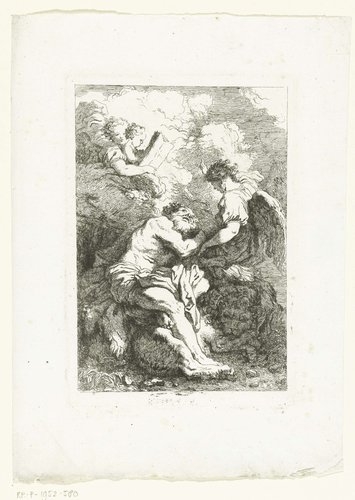
Heilige Hieronymus
1763 - 1764
Medium
etching
Dimensions
113; 165
Rights
Public Domain
About this artwork
plaatrand: hoogte 165 mm x breedte 113 mm
Art Historical Context
Jean Honoré Fragonard *Heilige Hieronymus (Saint Jerome), created between 1763 and 1764, is a delicate etching measuring 165 mm high by 113 mm wide. Fragonard, a master of the French Rococo style, is best known for his exuberant, sensual paintings of aristocratic life, yet this work reveals his early versatility in tackling religious themes. Saint Jerome, the scholar-saint often depicted in penitential solitude with a lion, skull, and crucifix, reflects the enduring Catholic iconography popular in 18th-century Europe amid the lingering influence of Baroque drama. As an etching, the piece showcases Fragonard’s mastery of intaglio printmaking, where acid etches intricate lines into a metal plate, allowing for fluid, expressive strokes that capture Rococo’s playful elegance even in a devotional subject. Produced during Fragonard’s formative years after his Prix de Rome training in Italy, it bridges his ornate style with classical restraint, hinting at the stylistic shifts toward Neoclassicism. This intimate-scale print would have appealed to collectors seeking affordable art, underscoring etching’s role in democratizing high art. A charming glimpse into Fragonard’s range, it invites us to ponder the saint’s quiet contemplation in the artist’s whimsical hand.
About the Artist
Jean Honoré Fragonard · 1732–1806
Jean-Honoré Fragonard (1732-1806) was a French painter and printmaker whose late Rococo manner was distinguished by remarkable facility, exuberance, and hedonism. Born in Grasse, he moved to Paris where he trained under Jean-Baptiste Chardin and François Boucher, winning the prestigious Prix de Rome in 1752. After studying in Italy alongside Hubert Robert, Fragonard returned to Paris in 1761 to fi...