
English Peasant (Paysan anglais)
1826 to 1850
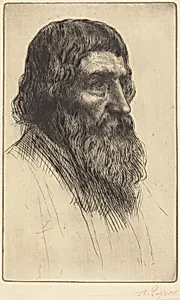
Medium
etching and drypoint?
Classification
Department
CG-E
Museum
National Gallery of Art, Washington, D.C.
Credit
Rosenwald Collection
Accession Number
1943.3.5338
Rights
Public Domain
Art Historical Context
**English Peasant (Pan anglais)**, an etching and drypoint by artist Alphonse Leg (1837–1911), captures the rugged dignity of rural life in mid-19th-century England Created sometime between 1826 and1850—likely during Legros's early career—this print reflects his fascination with the working class, a theme central to the Realism movement. Legros, who later became a prominent figure in London's scene, drew inspiration from everyday peasants, portraying them with empathy amid the social upheavals of industrialization. The medium of etching and drypoint exemplifies Legros's mastery of printmaking. Etching involves drawing lines on a metal plate coated with acid-resistant ground, then submerging it in acid to etch the lines; drypoint adds direct scratches that create a velvety burr for rich, expressive tones. This combination allowed Legros to achieve intricate textures and subtle shading, evoking Rembrandt's influence in the 19th-century etching revival. Housed in the National Gallery of Art's Rosenwald Collection (Department CG-E), it highlights the era's technical innovations in affordable art reproduction. This work holds cultural significance as a bridge between French Realism and English art, underscoring the humanity of the laboring poor. Visitors will appreciate its intimate scale and poignant realism, inviting reflection on class and countryside in a changing world. (198 words)
About the Artist
Alphonse Legros · 1837–1911
Alphonse Legros (1837–1911) was born in Dijon, France, and trained in Paris at the drawing school of Horace Lecoq de Boisbaudran, whose unconventional teaching method — which emphasised memory drawing and acute observation over academic convention — would leave a lasting mark on Legros's practice. At Lecoq's school he formed friendships with Jules Dalou and Auguste Rodin that endured throughout hi...