
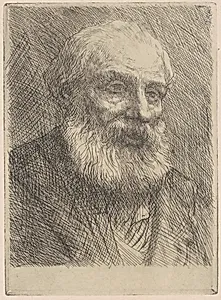
Head of an Old Man (Tête de vieillard)
late 19th century
Medium
etching [aquatint?]
Classification
Department
CG-E
Museum
National Gallery of Art, Washington, D.C.
Credit
Corcoran Collection (Gift of E. Gerald Lamboley)
Accession Number
2015.143.1364
Rights
Public Domain
Art Historical Context
Alphonse Legros' *Head of an Old ManTête de vieillard)*, created in the late 19 century, captures the weathered dignity of age through the intimate medium of etching—possibly enhanced with aquatint for tonal effects. A French-born artist who later became a pivotal figure in London's art scene, Legros was a master Realist whose prints drew inspiration from 17th-century masters like Rembrandt. This work exemplifies his fascination with human character, rendering the subject's lined face, piercing gaze, and tousled hair with remarkable sensitivity and depth. Etching, an intaglio technique where acid etches intricate lines into a metal plate, allowed Legros to achieve exquisite detail and texture—evident in the fine wrinkles and shadowed contours that convey both vulnerability and resilience. As part of the 19th-century etching revival, Legros' prints bridged academic tradition and modern expressiveness, influencing British artists at the Slade School, where he taught. Now housed in the National Gallery of Art's Corcoran Collection (gift of E. Gerald Lamboley), this poignant study invites visitors to ponder the universal stories etched into a single face, reminding us of Legros' enduring legacy in elevating printmaking to fine art.
About the Artist
Alphonse Legros · 1837–1911
Alphonse Legros (1837–1911) was born in Dijon, France, and trained in Paris at the drawing school of Horace Lecoq de Boisbaudran, whose unconventional teaching method — which emphasised memory drawing and acute observation over academic convention — would leave a lasting mark on Legros's practice. At Lecoq's school he formed friendships with Jules Dalou and Auguste Rodin that endured throughout hi...