
Ephraim Bonus, Jewish Physician
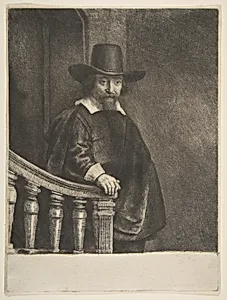
Medium
Etching, engraving and drypoint; second of two states
Dimensions
Sheet: 9 5/8 × 7 3/16 in. (24.5 × 18.2 cm) Plate: 8 3/16 × 6 15/16 in. (20.8 × 17.7 cm)
Classification
Prints
Department
Drawings and Prints
Museum
Metropolitan Museum of Art, New York, NY
Credit
Gift of Felix M. Warburg and his family, 1941
Accession Number
41.1.18
Rights
Public Domain
Tags
Art Historical Context
In the intimate world of Rembrandt van Rijn's prints, *Ephraim Bonus, Jewish* stands as a compelling portrait from the master's etching oeuvre. Created during Rembrandt's Amsterdam years in the Dutch Golden Age, this work captures Dr. Bonus, a prominent Jewish physician, with the artist's signature psychological depth. Though the exact date is unknown, it Rembrandt's fascination with diverse sitters from his vibrant, multicultural city, where Jewish intellectuals like Bonus thrived after fleeing the Inquisition. This second state of the print masterfully combines etching, engraving, and drypoint techniques—Rembrandt's innovations that allowed for rich, textured lines and velvety burrs evoking the softness of flesh and fur. The modest plate size (8 3/16 × 6 15/16 in.) belies its monumental presence, showcasing the tactile possibilities of intaglio printing. As a gift to the Metropolitan Museum of Art from Felix M. Warburg and family in 1941, it preserves Rembrandt's genius in black-and-white portraiture. Culturally, the depiction highlights 17th-century Amsterdam's tolerant Jewish community and medical advancements, with Bonus embodying the era's learned professionals. A testament to Rembrandt's empathetic gaze, this print invites viewers to ponder the humanity behind historical faces.
About the Artist
Rembrandt (Rembrandt van Rijn) · 1606–1669
Rembrandt Harmenszoon van Rijn (1606–1669) stands as one of the greatest visual artists in the history of Western art and the most important Dutch painter of the 17th century. Born in Leiden to a prosperous miller's family, Rembrandt transformed painting through his revolutionary use of light and shadow, his psychological depth in portraiture, and his elevation of etching to a fine art. His approx...