
Equal-Arm Brooch
Unknown Artist
7th–8th century
Medium
Copper alloy, glass beads, wax
Dimensions
Overall: 1 11/16 x 13/16 x 11/16 in. (4.3 x 2 x 1.8 cm)
Classification
Metalwork-Copper alloy
Culture
Frankish
Department
Medieval Art
Museum
Metropolitan Museum of Art, New York, NY
Credit
Gift of J. Pierpont Morgan, 1917
Accession Number
17.192.13
Rights
Public Domain
Art Historical Context
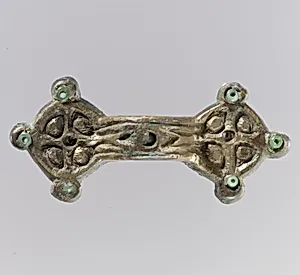
This delicate Equal-Arm Brooch crafted by an unknown Frankish artisan in the 7th–8th century, exemplifies refined metalwork of early medieval Europe during the Merovingian era. Hailing from the Frankish culture that dominated much of what is now France and Germany this small jewelry piece—measuring just 1 11/16 x 13/16 x 11/16 inches—was likely used to fasten cloaks or garments, blending functionality with subtle elegance. Its symmetrical "equal-arm" design, a hallmark of Frankish brooches, reflects the era's preference for balanced forms inspired by late Roman traditions. Fashioned from copper alloy with inlaid glass beads and wax, the brooch showcases sophisticated techniques accessible to skilled workshops. The copper alloy provided durability for everyday wear, while colorful glass beads added vibrant accents, possibly evoking precious gems for those of modest means. Wax likely served as an adhesive or sealant, highlighting innovative methods to enhance both beauty and longevity. A treasured artifact in the Metropolitan Museum of Art's Medieval Art Department, gifted by J. Pierpont Morgan in 1917, this brooch offers a glimpse into Frankish daily life and craftsmanship. It whispers of a world where personal adornment signified identity and status amid the transitions of the early Middle Ages.