
Equal-Arm Brooch
Unknown Artist
ca. 650–750
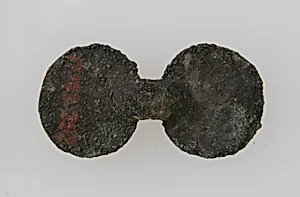
Medium
Copper alloy
Dimensions
Overall: 1 1/8 x 9/16 x 3/16 in. (2.9 x 1.5 x 0.5 cm)
Classification
Metalwork-Copper alloy
Culture
Frankish
Department
Medieval Art
Museum
Metropolitan Museum of Art, New York, NY
Credit
Gift of J. Pierpont Morgan, 1917
Accession Number
17.193.292
Rights
Public Domain
Art Historical Context
This delicate Equal-Arm Brooch crafted by an unknown Frankish artisan around 650–750 CE, the refined metalworking of early medieval Europe. just 1 1/8 x 9/16 x 3/16 inches, its symmetrical design—hallmark of the "equal-arm"—features two mirror-image arms converging at a pin mechanism, ideal for fastening cloaks or garments. Fashioned from copper alloy, a durable and accessible material, it highlights the Franks' skill in casting and shaping metals for both function and subtle ornamentation. Hailing from the Merovingian era, when the Franks dominated much of Western Europe, this brooch offers a glimpse into daily life and social status among the elite. Such jewelry was more than utilitarian; it symbolized identity and craftsmanship in a turbulent post-Roman world, blending Germanic traditions with emerging Christian influences. Its presence in the Metropolitan Museum of Art's Medieval Art collection, gifted by J. Pierpont Morgan in 1917, underscores its rarity as a survivor from this formative period. Though small, the brooch's precise proportions and enduring form speak to the artistry of Frankish metalworkers, bridging utility and aesthetic appeal in an age of transformation.