
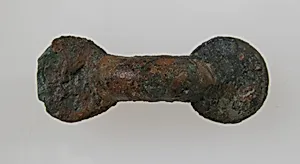
Equal-Arm Brooch
Unknown Artist
ca. 650–750
Medium
Copper alloy
Dimensions
Overall: 1 5/8 x 9/16 x 9/16 in. (4.1 x 1.5 x 1.4 cm)
Classification
Metalwork-Copper alloy
Culture
Frankish
Department
Medieval Art
Museum
Metropolitan Museum of Art, New York, NY
Credit
Gift of J. Pierpont Morgan, 1917
Accession Number
17.193.324
Rights
Public Domain
Art Historical Context
This delicate Equal-Arm Brooch, crafted by an unknown Frankish artisan around 650–750 CE, exemplifies the refined metalworking of the early medieval Merovingian period. Measuring just 1 5/8 x 9/16 x 9/16 inches, its symmetrical "equal-arm" design—two mirrored arms meeting at a central pin mechanism—was ingeniously engineered to fasten cloaks or garments securely. Made from copper alloy, a durable and accessible material, it highlights the Franks' skill in casting and shaping metals for both function and subtle ornamentation. In Frankish culture, which dominated much of western Europe during this era, such brooches were more than practical accessories; they served as status symbols for elites and warriors, often worn on the shoulder to display wealth and craftsmanship. This piece reflects the transition from late antiquity to the Middle Ages, blending Roman influences with emerging Germanic motifs in a compact form. Its survival speaks to the enduring legacy of Frankish artistry amid the turbulent post-Roman world. Generously gifted to The Metropolitan Museum of Art by J. Pierpont Morgan in 1917, the brooch invites us to imagine the daily lives of 8th-century Franks, where even everyday objects carried artistic pride. A true gem of Medieval Metalwork, it reminds visitors of the ingenuity hidden in history's smallest treasures.