
Equestrian Statue of Marcus Aurelius
1757
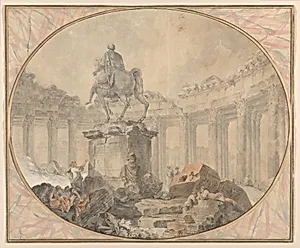
Medium
Pen and black ink, brush and gray and brown wash, pale rose watercolor and white heightening over black chalk.
Dimensions
19 1/16 x 23 1/8 in. (48.4 x 58.8 cm)
Classification
Drawings
Department
Robert Lehman Collection
Museum
Metropolitan Museum of Art, New York, NY
Credit
Robert Lehman Collection, 1975
Accession Number
1975.1.693
Rights
Public Domain
Tags
Art Historical Context
Welcome to the Metropolitan Museum of Art's Robert Lehman Collection, where Hubert Robert's *Equestrian Statue of Marcus Aurelius* (7) captivates with its evocative depiction of ancient grandeur. This intricate drawing portrays the iconic bronze statue of the Roman Emperor Marcus Aurelius, perched triumphantly on horseback amid the atmospheric ruins of Rome. Created during Robert's formative years in Italy, it reflects the artist's lifelong passion for classical antiquity, earning him the nickname "Robert Ruines." A master of the picturesque and neoclassical styles, Robert blends precise architectural observation with romantic imagination, evoking the sublime decay of empire. The subject—a 2nd-century AD monument symbolizing Stoic wisdom and imperial power—holds enduring cultural importance as one of the few surviving ancient equestrian statues, once mistaken for Constantine the Great. Executed in pen and black ink with gray and brown washes, pale rose watercolor, and white heightening over black chalk, the work showcases 18th-century drafting techniques that build dramatic light, shadow, and texture. Measuring 19 x 23 inches, this sheet likely served as both study and standalone artwork, inviting viewers to ponder the dialogue between past glory and present contemplation. A gem for lovers of history and draftsmanship!
About the Artist
Hubert Robert · 1733–1808
Hubert Robert, born on May 22, 1733, in Paris, emerged from a modest background; his father, Nicolas Robert, served the influential Choiseul family, whose patronage shaped the young artist's path. After completing his studies at the Jesuit Collège de Navarre in 1751, he entered the atelier of sculptor Michel-Ange Slodtz, who taught him design and perspective before encouraging a shift to painting....