
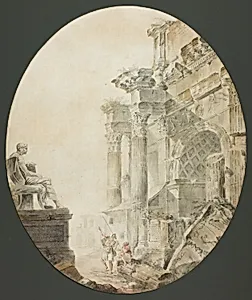
Arch of Constantine with Statue of Nero
c. 1770
Medium
Pen and black ink and brush and gray wash, with watercolor, on ivory oval-shaped laid paper
Dimensions
48.6 × 40.8 cm (19 3/16 × 16 1/8 in.)
Classification
pen and ink drawings
Department
Prints and Drawings
Museum
Art Institute of Chicago
Accession Number
149043
Rights
Public Domain
Art Historical Context
Hubert Robert, the renowned 18th-century French artist known as "Robert desines," masterfully captures the timeless allure of ancient Rome in his *Arch of Constantine with Statue of* (c. 1770). Having spent over a decade sketching Rome's monuments from 1755 to 1765, Robert infused this work with his signature neoclassical style, blending precise architectural detail with a poetic sense of decay and grandeur. The composition centers on the iconic Arch of Constantine, a triumphal monument from 312–315 CE commemorating Emperor Constantine's victory, but Robert adds a dramatic flourish with an imagined statue of Nero atop it—evoking the emperor's notorious legacy amid Rome's layered history. Executed on an elegant oval-shaped ivory laid paper, the drawing employs pen and black ink for sharp outlines, brush and gray wash for atmospheric depth, and subtle watercolor for luminous highlights. This mixed-media technique, popular among Grand Tour artists, creates a luminous, almost three-dimensional illusion, drawing viewers into a romantic reverie of antiquity. Measuring nearly 20 by 16 inches, its intimate scale invites close contemplation. Housed in the Art Institute of Chicago's Prints and Drawings department, this piece reflects the Enlightenment-era fascination with classical ruins, symbolizing both imperial glory and the passage of time. Robert's vision not only preserves Rome's splendor but also inspires wonder at how art reimagines history for modern eyes.
About the Artist
Hubert Robert · 1733–1808
Hubert Robert, born on May 22, 1733, in Paris, emerged from a modest background; his father, Nicolas Robert, served the influential Choiseul family, whose patronage shaped the young artist's path. After completing his studies at the Jesuit Collège de Navarre in 1751, he entered the atelier of sculptor Michel-Ange Slodtz, who taught him design and perspective before encouraging a shift to painting....