
Erotic Print
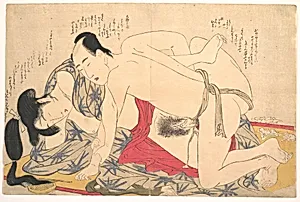
Medium
Woodblock print; ink and color on paper
Dimensions
Image: 10 in. × 15 1/8 in. (25.4 × 38.4 cm) Mat: 15 1/2 × 22 3/4 in. (39.4 × 57.8 cm)
Classification
Prints
Culture & Period
Japan · Edo period (1615–1868)
Department
Asian Art
Museum
Metropolitan Museum of Art, New York, NY
Credit
Anonymous Gift, 1952
Accession Number
JP3164
Rights
Public Domain
Tags
Art Historical Context
Created during Japan’s Edo period (1615–1868), this woodblock print by Kitagawa Utamaro exemplifies vibrant tradition of uki-e, or “pictures of the floating world.” Utamaro, celebrated for his sensitive portrayals of women and intimate scenes, was one of the most inventive print designers of his time. Works like this one, often called shunga (“spring pictures”), formed a lively, if discreetly circulated, part of Edo visual culture, offering candid explorations of human desire within the refined aesthetic of Japanese printmaking. Printed with ink and color on paper, the medium allowed artists to reach wide audiences through multiple impressions. Utamaro’s elegant line work and subtle gradations of color bring a sense of grace and vitality to the figures, transforming an erotic subject into a study of form and emotion. Such prints were enjoyed privately, frequently exchanged as gifts or kept in albums, reflecting both the playful and artistic spirit of urban Edo society. Today, this sheet in the Metropolitan Museum’s collection invites viewers to appreciate the technical mastery and cultural openness that shaped Japanese art of the period.
About the Artist
Kitagawa Utamaro · 1753–1806
Kitagawa Utamaro (c. 1753-1806) was one of the most celebrated masters of ukiyo-e woodblock printing, revolutionizing the art of bijin-ga (pictures of beautiful women) during Japan's Edo period. Born Kitagawa Ichitaro, his early life remains shrouded in mystery, with conflicting accounts placing his birth in Kyoto, Osaka, Yoshiwara in Edo (modern Tokyo), or Kawagoe in Musashi Province. Under the t...