
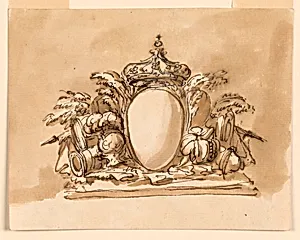
Escutcheon
1746–1809
Classification
architecture
Department
Smithsonian Collection
Museum
Smithsonian American Art Museum
Credit
Museum purchase through gift of various donors and from Eleanor G. Hewitt Fund
Accession Number
1938-88-1830
Rights
Public Domain
About this artwork
Research in Progress
Art Historical Context
**Escutcheon** Giuseppe Barberi (, 1746–1809)* Step into the neoclassical world of Giuseppe Barberi, a prominent Italian architect active in Rome during the late 18th century. This *Escutcheon*, housed in the Smithsonian American Art's architecture collection, represents Barberi's mastery of decorative design from his era (1746–1809). through museum purchase with gifts from various donors and the Eleanor G. Hewitt, it embodies the refined ornamentation that graced grand European interiors. Classified as an architectural element, an escutcheon typically served as a protective or decorative shield around keyholes, locks, or hinges on doors and furniture—often bearing heraldic motifs symbolizing family lineage or prestige. Barberi's work aligned with the neoclassical revival, drawing on ancient Roman forms for symmetry and elegance, making such pieces both functional and symbolically rich. Though research continues to uncover specifics about its medium and exact provenance, this artifact highlights the enduring allure of Italian design in American collections, bridging 18th-century Europe with modern appreciation for architectural artistry. A subtle yet striking testament to Barberi's legacy! (178 words)