
Estzan-Nap-Pa
Medium
Painting
Classification
Painting
Department
Smithsonian Collection
Museum
Smithsonian American Art Museum
Credit
Smithsonian American Art Museum, Bequest of Victor Justice Evans
Accession Number
1985.66.362,136
Rights
Public Domain
Tags
About this artwork
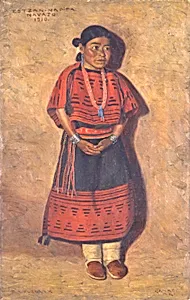
Elbridge Ayer Burbank created nearly one thousand paintings of Native Americans between 1897 and 1910. All of his portraits feature an indistinct background and either a bust-length or full-length view of his subject. Every choice he made was intended to document as much information about the subject’s outward appearance as possible. In this portrait of a Navajo woman, Burbank shows Estzan-Nap-Pa full length in order to display her dress. By turning her head just slightly to provide a three-quar...
Art Historical Context
Elbridge Ayer Burbank a prolific artist who painted nearly 1,000 of Native Americans between 1897 and 1910, captured *Estzan-Nap-Pa*, a Navajo woman, in this full-length oil painting from 1910 Now housed in the Smithsonian American Art, the work exemplifies Burbank's mission to document indigenous peoples at a time when he believed their traditional ways were vanishing. His portraits, often featuring indistinct backgrounds, prioritized physical details over personality, serving as visual records for future study. Burbank's deliberate choices shine here: the full-length pose showcases Estzan-Nap-Pa's intricate Navajo dress, while a subtle three-quarter turn highlights her facial features. This approach reflected his fascination with anthropological classification systems, linking appearance to behavior. Rather than evoking emotion, the painting preserves a "type"—a snapshot of cultural attire and physiognomy amid rapid change. Today, *Estzan-Nap-Pa* offers a window into early 20th-century attitudes toward Native Americans, blending art with ethnography. Burbank's urgent words—"it will not be long before [the Indians are] all gone forever"—underscore the era's paternalistic preservation efforts, inviting visitors to reflect on representation and resilience in Native art.