
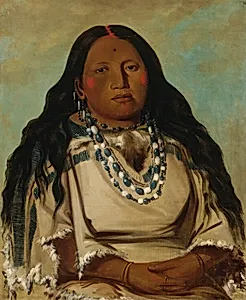
Kah-béck-a, The Twin, Wife of Bloody Hand
1832
Medium
Painting
Classification
Painting
Department
Smithsonian Collection
Museum
Smithsonian American Art Museum
Credit
Smithsonian American Art Museum, Gift of Mrs. Joseph Harrison, Jr.
Accession Number
1985.66.124
Rights
Public Domain
Tags
About this artwork
The Twin was the wife of Bloody Hand, chief of the Arikara tribe. George Catlin painted both their portraits during his travels West in 1832. This portrait was painted at a Mandan village.
Art Historical Context
**Kah-béck-a, The Twin, Wife Bloody Hand** (1832) is a compelling portrait by George Catlin the pioneering American artist renowned for his vivid documentation of Native American life in the early 19th century. Catlin, a self-taught painter influenced by Romanticism, captured bust-length image of Kah-béck-a, the wife of Bloody Hand, chief of therikara tribe. Dressed in traditional Indian attire highlights intricate beadwork and feathers, her poised expression conveys quiet strength and cultural pride, painted on-site at a Mandan village during Catlin's ambitious 1832 expedition up the Missouri River. This oil painting holds immense historical significance as part of Catlin's mission to record Indigenous peoples before rapid westward expansion and disease altered their worlds forever. The Arikara, a resilient Plains tribe known for their fortified villages and agriculture, faced devastating conflicts around this time, making Kah-béck-a's portrait a rare glimpse into their daily nobility. Catlin's realistic technique—marked by sharp details in skin tones, fabrics, and accessories—elevates it beyond mere likeness, preserving cultural identity for posterity. Today, housed in the Smithsonian American Art Museum, this work invites visitors to reflect on the humanity behind historical encounters, reminding us of the diverse voices of America's original inhabitants. (198 words)
About the Artist
George Catlin · 1796–1872
George Catlin (1796–1872), born in Wilkes-Barre, Pennsylvania, to Putnam Catlin and Polly Sutton—who had been captured by Native Americans during the 1778 Battle of Wyoming—initially pursued a legal career. Trained at Litchfield Law School, he was admitted to the bar in 1819 but abandoned law after two years to study art in Philadelphia in 1823. Self-taught as a portraitist, Catlin quickly gained ...