
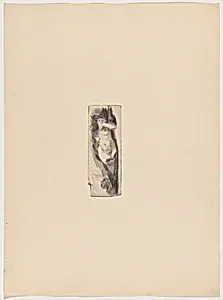
Etude de nu (Study of a Nude)
1895
Medium
softground etching and drypoint in black on heavy japan paper
Dimensions
plate: 4.3 x 11.9 cm (1 11/16 x 4 11/16 in.) sheet: 28 x 38 cm (11 x 14 15/16 in.)
Classification
Department
CG-E
Museum
National Gallery of Art, Washington, D.C.
Credit
Virginia and Ira Jackson Collection, gift in memory of Virginia H. Jackson
Accession Number
1996.151.52
Rights
Public Domain
Art Historical Context
Félicien Rops' *Étude de nu (Study a Nude)*, in 1895, the Belgian artist's fascination with the human form during the fin-de-siècle era. A master of Symbolism and the Decadent movement, R often explored eroticism, fantasy, and the macabre, blending sensuality with subtle psychological depth. This intimate print, measuring just 4.3 x 11.9 cm on the plate, exemplifies his late-career prowess, produced as he pushed artistic boundaries amid Europe's cultural upheavals. Executed in softground etching and drypoint on heavy Japan paper, the work showcases Rops' technical virtuosity. Softground etching allows for textured, almost painterly effects by pressing textured materials into the softened ground on the plate, while drypoint's direct needle incisions create velvety burr lines that hold rich black ink. The luxurious Japan paper enhances these qualities, absorbing ink deeply for dramatic contrasts—ideal for small-scale studies that invite close viewing. Housed in the National Gallery of Art's Virginia and Ira Jackson Collection (gift in memory of Virginia H. Jackson), this print reflects Rops' enduring influence on modern printmaking and erotic art. It invites visitors to ponder the nude not just as anatomy, but as a symbol of desire and decadence in a changing world.
About the Artist
Félicien Rops · 1833–1898
Félicien Rops, born Félicien Victor Joseph Rops on July 7, 1833, in Namur, Belgium, to a prosperous textile manufacturing family, displayed prodigious artistic talent from youth. The only child of Nicholas Rops and Sophie Maubile, he received private tutoring until age ten, followed by education at a Jesuit school in Namur (1843–1848), the Athénée Royal de Namur, and the Academy of Fine Arts there...