
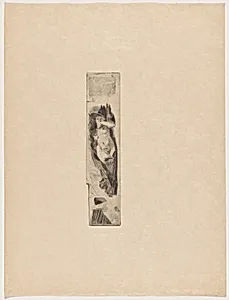
Etude de nu (Study of a Nude)
1895
Medium
softground etching and drypoint in black on heavy japan paper
Dimensions
plate: 4.2 x 19.4 cm (1 5/8 x 7 5/8 in.) sheet: 27.9 x 36.9 cm (11 x 14 1/2 in.)
Classification
Department
CG-E
Museum
National Gallery of Art, Washington, D.C.
Credit
Virginia and Ira Jackson Collection, gift in memory of Virginia H. Jackson
Accession Number
1996.151.53
Rights
Public Domain
Art Historical Context
Félicien Rops, a pioneering Belgian artist of the fin-de-siècle era (1833–1898), created *Étude de nu (Study a Nude)* in 1895, a delicate yet provocative print that exemplifies his fascination with the human form, eroticism, and the macabre. Associated with Symbolism and the Decad movement, Rops often blended sensuality with psychological depth, challenging the prudish conventions of late 19th-century Europe. This intimate study captures the nude figure with a masterful intimacy, reflecting his role as an illustrator for avant-garde publications like Baudelaire's *Les Fleurs du Mal*. Executed in softground etching and drypoint on heavy Japan paper—a luxurious, textured support prized for its ability to hold fine ink details—the work showcases Rops' technical virtuosity. Softground etching allows for subtle tonal variations and lifelike textures, mimicking drawing on paper, while drypoint's incised lines create velvety burrs for rich, expressive shadows. At just 4.2 x 19.4 cm on the plate, its small scale invites close contemplation, heightening the viewer's personal encounter. Housed in the National Gallery of Art as part of the Virginia and Ira Jackson Collection, this print underscores Rops' enduring influence on modern erotic art, bridging 19th-century printmaking traditions with bold explorations of desire and mortality. A gem for visitors, it reveals how Rops transformed technical precision into profound sensuality.
About the Artist
Félicien Rops · 1833–1898
Félicien Rops, born Félicien Victor Joseph Rops on July 7, 1833, in Namur, Belgium, to a prosperous textile manufacturing family, displayed prodigious artistic talent from youth. The only child of Nicholas Rops and Sophie Maubile, he received private tutoring until age ten, followed by education at a Jesuit school in Namur (1843–1848), the Athénée Royal de Namur, and the Academy of Fine Arts there...