
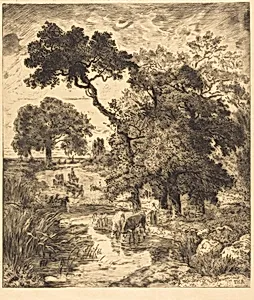
Evening
Medium
etching and drypoint on Japan paper
Dimensions
image: 45 × 39.1 cm (17 11/16 × 15 3/8 in.) plate: 47.7 × 40 cm (18 3/4 × 15 3/4 in.) sheet: 58.9 × 46.4 cm (23 3/16 × 18 1/4 in.)
Classification
Department
CG-E
Museum
National Gallery of Art, Washington, D.C.
Credit
Ailsa Mellon Bruce Fund
Accession Number
1981.1.1
Rights
Public Domain
Art Historical Context
**Evening**, an exquisite 1882 etching and drypoint by Félix Bracquemond Théodore Rousseau, captures the serene hush of twilight in a masterful print on delicate Japan paper. Rousseau, a leading figure of the Barbizon School 19th-century French movement unidealized nature—painted poetic landscapes that influenced Impressionism. Bracquemond, a etcher and proponent of the etching revival, faithfully translated Rousseau's vision into intricate lines, preserving the original's moody atmosphere of fading light and shadowed foliage. The medium shines here: etching creates precise, acid-bitten lines for structure, while drypoint adds velvety burrs from direct needle scratches, lending a painterly softness ideal for evoking evening's subtle tones. Printed on fine Japan paper, known for its absorbency and texture, the work measures a generous plate size of 47.7 × 40 cm, allowing immersive detail. This technique bridged painting and printmaking, making Rousseau's art accessible to wider audiences during a print renaissance. Acquired through the Ailsa Mellon Bruce Fund for the National Gallery of Art's print collection, *Evening* exemplifies 19th-century innovation in reproductive prints, honoring nature's quiet drama while showcasing technical prowess. A perfect gem for contemplating dusk's gentle mystery.