
Evening
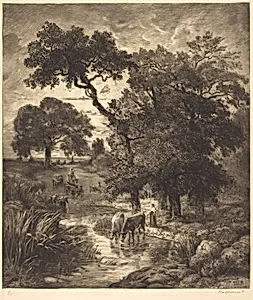
Medium
etching and drypoint on Japan paper
Dimensions
image: 45 × 39 cm (17 11/16 × 15 3/8 in.) plate: 47.5 × 39.8 cm (18 11/16 × 15 11/16 in.) sheet: 57.7 × 46 cm (22 11/16 × 18 1/8 in.)
Classification
Department
CG-E
Museum
National Gallery of Art, Washington, D.C.
Credit
Gift of The Atlas Foundation
Accession Number
1982.88.1
Rights
Public Domain
Art Historical Context
This evocative etching captures the tranquil essence of a landscape at dusk, rendered by master printmaker Félix Bracquemond after an original composition by Théodore Rousseau. Rousseau, a leading figure of the Barbizon School, was celebrated for his intimate portrayals of the French countryside, particularly the forests around Fontainebleau. Created in 1882—well after Rousseau’s death in 1867—Bracquemond’s interpretation pays homage to the earlier artist’s reverence for nature while showcasing the printmaker’s own technical brilliance. Bracquemond employed etching and drypoint on delicate Japan paper, techniques that allow for rich, velvety lines and subtle tonal gradations. The drypoint needle creates soft, burr-like edges that hold ink beautifully, evoking the atmospheric depth of Rousseau’s painted skies and foliage. Such reproductive prints played an important cultural role in the nineteenth century, bringing celebrated paintings to wider audiences through affordable yet artistically sophisticated editions. Now part of the National Gallery of Art’s collection through the generous gift of The Atlas Foundation, “Evening” exemplifies the fruitful dialogue between painting and printmaking during this period. It invites viewers to appreciate both the quiet poetry of the landscape and the meticulous craft that preserves it across media.