
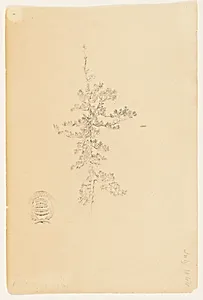
Evergreen Tree, Catskill, New York
Classification
nature studies
Department
Smithsonian Collection
Museum
Smithsonian American Art Museum
Credit
Gift of Louis P. Church
Accession Number
1917-4-1-c
Rights
Public Domain
About this artwork
Research in Progress
Art Historical Context
Frederic Edwin Church's *Evergreen Tree, Catskill, New York created in July 1844, captures the rugged vitality of the Catskill Mountains, a beloved landscape for 19th-century American artists At just 18 years old, Church—already a promising talent under the tutelage of Hudson River School founder Thomas Cole—produced this nature study during a formative summer sketching trip. The Catskills, with their dramatic peaks and lush forests, symbolized America's untamed wilderness, inspiring a new national identity rooted in natural grandeur. Classified as a nature study from the Smithsonian American Art Museum's collection (gift of Louis P. Church), this work highlights Church's meticulous observation of organic forms. Though the medium remains unidentified amid ongoing research, such studies were essential to Hudson River School practice, serving as preparatory sketches for larger canvases that celebrated divine harmony in nature. Church's early focus on individual trees like this evergreen foreshadowed his mastery of luminous, detailed landscapes, blending scientific precision with romantic awe. This intimate piece offers a window into Church's beginnings, reminding us how close studies of nature fueled the epic visions that defined American Romanticism. Visit it to feel the whisper of Catskill winds preserved in time.