
Ewer
ca. 1761
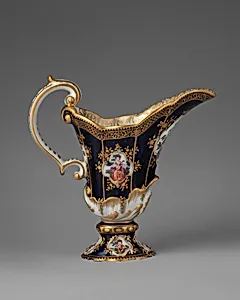
Medium
Soft-paste porcelain
Dimensions
8 1/4 × 8 1/2 in. (21 × 21.6 cm)
Classification
Ceramics-Porcelain
Culture
British, Chelsea
Department
European Sculpture and Decorative Arts
Museum
Metropolitan Museum of Art, New York, NY
Credit
Gift of Irwin Untermyer, 1964
Accession Number
64.101.495
Rights
Public Domain
Tags
Art Historical Context
This elegant ewer, crafted by the renowned Chelsea Porcelain Manufactory 1761, exemplifies the artistry of mid-18th-century British ceramics. Standing at 8¼ × 8½ inches, it is made of soft-paste porcelain—a delicate, translucent material that mimicked prized Chinese hard-paste porcelain but was fired at lower temperatures, allowing for intricate modeling and vibrant enameling. The piece likely features decorative motifs of women musicians, capturing the era's fascination with female figures in leisurely pursuits, rendered with fine detail and a sense of Rococo whimsy. Chelsea, established in the 1740s near London, was among England's pioneering porcelain factories, producing luxury wares for aristocratic homes during the height of the Georgian period. Soft-paste porcelain represented a technological breakthrough, blending clay, glass frit, and other ingredients to achieve a creamy glow and subtle strength, often enhanced with gilding and colorful overglaze enamels. This ewer, now in the Metropolitan Museum of Art thanks to a 1964 gift from Irwin Untermyer, reflects the factory's "gold anchor" phase, known for its high-quality figurative scenes. As a decorative vessel, the ewer served both practical and ornamental roles, symbolizing refined taste and cultural sophistication. Its themes of women musicians evoke the Enlightenment-era celebration of music and femininity, making it a charming window into 18th-century British opulence and innovation in the decorative arts.
About the Artist
Chelsea Porcelain Manufactory · 1744–1784
**Chelsea Porcelain Manufactory** The Chelsea Porcelain Manufactory, Britain's pioneering porcelain enterprise, was founded around 1743 in Chelsea, London, by two Huguenot silversmiths: Nicholas Sprimont from Liège and Charles Gouyn. Sprimont, trained in Paris as a goldsmith before immigrating to England, brought his expertise in luxury metalwork to the venture, while Gouyn handled early sales th...